

William Friedkin, the (in)famous director of classic masterpieces The Exorcist and the Best Picture-winning The French Connection, is a fascinating case. By many accounts, he was incredibly stubborn and difficult to work with, but (especially when it comes to his 20th-century works) he consistently turned out stellar cinematic experiences. Friedkin’s renowned line of work does not excuse his alleged obtrusiveness, but it can’t be denied that when he committed to a project, he committed to it.
That commitment is key to one of his most forgotten films, 1977’s Sorcerer, which I watched last night after hearing raves about it from various film circles for years. It had a resurgence on the film social media site Letterboxd after Friedkin’s death last summer and has been on my watchlist ever since.

Sorcerer is the second adaptation of Georges Arnaud’s seminal 1950 novel Le Salaire de la peur, following the lauded 1953 French film The Wages of Fear, which many assumed Sorcerer was a direct remake of (though Friedkin himself disagreed, proclaiming it as a pure adaptation of the novel). Sorcerer was initially envisioned as a smaller project with a modest budget of $2.5 million, though Friedkin would eventually insist on a bigger production. The budget ballooned to $22 million, forcing two studios (Universal and Paramount) to front the costs as production troubles and on-set conflicts kept delaying the completion of the shooting. Friedkin’s ethos, according to his memoir The Friedkin Connection, was that this movie would be his legacy; thus, it did not matter how much it cost and how behind schedule it got. This is what he would be remembered for.
The budget may have been higher than expected, but you can see the money on screen. Riots featuring hundreds of extras, multiple elaborate explosions, and location shooting in locations across the world including Paris, Israel, and the Dominican Republic are just some of the ways the massive undertaking is visually manifested, and it’s truly impressive how it grounds the experience. Certain moments – a sudden silence, the slight skid of a truck tire, sand hissing out of a bag – have ripple effects that you can’t help but feel in a shiver down your spine.
This movie is the epitome of “they don’t make ’em like they used to.” Everything is shot practically and on location, and that earned quality is a testament to just how real everything looks. These biomes and environments could never be replicated by more modern technology like the Volume, which is being used more and more in major productions, including everything Star Wars and Marvel produce. The Volume can make things look real, but not necessarily feel real. The tangible nature of reality always triumphs, and I’ve never seen it portrayed with more confident immersion than in Sorcerer. There are sequences where we go minutes without dialogue, soaking up the sights and sounds of a new location and adjusting to it in what feels like in real time. It’s phenomenal filmmaking and deserves to be seen as such.
Sorcerer, unfortunately, had the bad luck to open June 24, 1977, exactly one month after the theatrical premiere of one of the biggest phenomenons in cinematic history: Star Wars. It made half its budget back, constituting a major box office bomb. It was even negatively reviewed upon its release – another nail in the coffin for Friedkin’s “legacy.”
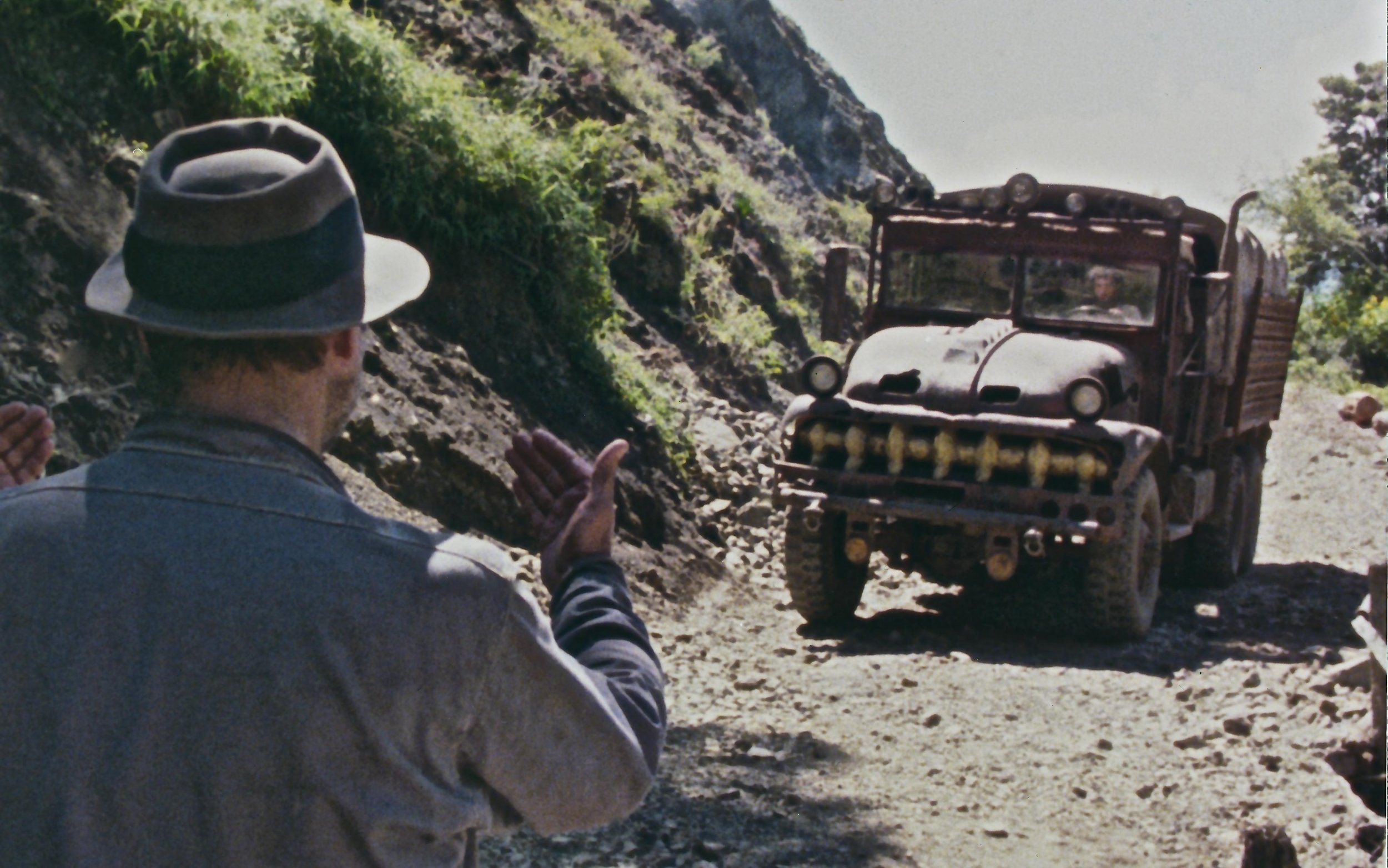
I’ve been going on and on about what this movie is, but I haven’t written a word of what it’s about. A prolonged prologue, populated by what some critics call “vignettes,” introduces us to the four protagonists: Nilo (Francisco Rabal) is a hitman who flees the scene of his latest crime in Veracruz; Kassem (Amidou) is a bomber who works with a terrorist cell in Israel; Victor Manzon (Bruno Cremer), a French banker, flees the country to escape charges of loan fraud; and Jackie Scanlon (Roy Scheider, by far the most recognizable face in the cast), a mob driver, escapes to South America after a robbery goes south. All four men are chosen to transport cargoes of highly volatile nitroglycerin in two massive trucks on a 200-mile path through a dangerous jungle to put out a chemical fire.
The first hour is set up. We get a sense of each character’s situation (some in more detail than others) through the four vignettes, which are perfectly paced – although this first act takes up nearly half the movie – and are done with minimal dialogue and overt exposition. The lack of dialogue is a staple throughout the film, and is strong evidence for the creative competence behind the film as a whole – Friedkin trusts the audience and treats their involvement with the story as such. He allows moments to breathe instead of ham-fisting an unnecessary piece of dialogue or an unfunny quip – the fate that befalls far too many adventure/thrillers today.
Every single second, both before and after the central four embark on their journey, is high-strung with tension. It’s so masterful that in the first hour, you often don’t realize that it’s slowly and steadily building until it spikes and releases all at once…only to do the same thing again ten minutes later. It often catches you off guard, and even when it doesn’t, its visceral style keeps you engaged for each and every one of those seconds.
Circling back to Friedkin’s aforementioned commitment – it would have been simple to shoot parts of Sorcerer on a soundstage or closed set. I’m sure the $2.5 million version of the film would have been more limited and not nearly as dynamic, but that’s more so how most movies are created in the 21st century, despite a host of new opportunities modern technology has afforded us. Less risks (both creative and physical) are taken because the Hollywood way of doing things is so different now. This is not necessarily a bad thing – safer productions and cost-saving efficiency can benefit the industry as a whole, but it’s noticeably different from the majority of the 20th century. We don’t get movies like Sorcerer anymore.

I’ve never seen another film like it – granted, I haven’t seen the original adaptation of The Wages of Fear yet – but my experience watching Sorcerer was unique and special, and it’s been a long time since I’ve been this floored by a first-time watch. There really should be a documentary about the production of this film, because based on what I’ve read, the production difficulties included a faulty explosion that was supposed to destroy an entire caoba tree (Friedkin reached out to a real arsonist whose identity has never been disclosed for help in portraying an accurate explosion), a camera crew that was fired after “losing confidence” in the production entirely, a feud that Friedkin had with local Teamsters, and several cast and crew members that had to leave the film because of gangrene, food poisoning, and malaria. It’s a shame that no documentary was produced while Friedkin was alive – his recollection and experience would be invaluable, and I’m incessantly interested in how this thing was finished in the first place.
This is, if nothing else, a plea for readers of this article to give Sorcerer a shot. Had it been released any other time or any other year, it may have been revered as a classic, but in the world we live in, it’s been largely forgotten, and is not on the radar of my generation entirely. It deserves a renaissance and a cultural reconsidering, and I’m more than happy to lead the charge.

 Knock on Wood
Leave a comment