

All of Us Strangers, a bizarrely overlooked critical darling of the 2023 awards season, is the incredibly emotionally effective story of Adam (Andrew Scott), a gay, middle-aged screenwriter who forms a relationship with a younger man (Paul Mescal) who lives in his sparsely-populated London apartment building. He also pays occasional visits to his childhood home in the suburbs, where his parents (Jamie Bell and Claire Foy), who died when he was a child, are mysteriously alive again. It’s a brilliant and thoughtful film that Knock on Wood contributor Davis Mathis labeled as “stunning” and “a must-see,” and contributor Robert Bouffard commended for “literaliz[ing] the cosmic power of love.”
Knock on Wood was lucky enough to interview the film’s editor, Mr. Jonathan Alberts, in January, the same month that All of Us Strangers continued its frustratingly limited theatrical release. As of February 22, it is available to stream on Hulu, and I urge all of the uninitiated to check it out as soon as possible.

The first thing we asked about was Alberts’ decade-long working relationship with writer/director Andrew Haigh, which has resulted in eight collaborations across film and television alike. Alberts first met Haigh on the film festival circuit in 2011; Haigh had written, directed, and edited a film called Weekend, and Alberts had edited the Drake Doremus film Like Crazy. “I didn’t see [Weekend at the festival], but I went to see it after it came out in theaters,” said Alberts, “and I really fell in love with it. I thought it was an amazing film, beautifully directed and written, and deeply felt. I was really interested in the filmmaker, and I thought, ‘Oh, I’d love to work with Andrew Haigh. But that’s not going to happen.”
Haigh was (and still is) based in London, and Alberts was working out of Los Angeles at the time. “I was at a different place in my career, but it seemed like, you know, [our careers] were similar sizes for what they were, so maybe we weren’t in such a different place. So I expressed interest to my agent, saying like ‘What is he working on? What’s happening with that?’ And I heard nothing; either they didn’t know, or they didn’t get back to me, I don’t really remember. But it was a little while later that I got a call and they said that Andrew Haigh and Michael Lannan are doing an untitled series for HBO.”
The series in question would eventually become Looking, which ran for two seasons from 2014 to 2016. But long before the show premiered, Alberts only knew sparse details, but he was most interested in the fact that Andrew Haigh was going to be in a prominent creative position. “I jumped at the opportunity to meet with him, and they were interested in meeting with me,” Alberts reminisced. “And the pilot for Looking was my first collaboration with Andrew, and I started to work with him more frequently after that.” Haigh and Alberts got along very well, so much so that Haigh brought Alberts on to his next feature, 45 Years. “Basically, since that first pilot, we’ve worked together on both TV shows and films. It’s been such a great collaborative working experience and friendship.”
Alberts has primarily worked in features, but has also done plenty of TV work. “On a film, you deal with the production company and studios, and in TV, you deal with the same people. But the thing about television is that there are a lot more layers of people. Things go through a lot of – I wouldn’t say a lot more scrutiny, but a lot more opinion. There are quite a lot of notes. A lot more executives, so you have many more opinions about what it should be and how it should be. You have showrunners, you might have a whole group of writers. You can have more than one director. So in a sense, like TV, from an editor’s perspective, feels a lot more like a factory than it does with a film.”
“And it doesn’t always have to feel like a factory product, that’s for sure. But, just in terms of moving through the process, the schedules are much shorter. The budgets can be higher than certain films, but you have less time to edit. So sometimes, you’ll have one day with the director or two or three days if it’s an hour-long show. Then you’ll have time with the producers, and then you’re done.”
Alberts and Haigh worked on All of Us Strangers “for 12 to 14 months just for an hour and 40 minutes,” Alberts laughed. “I think the other difference is that television is a different medium and it’s episodic, so naturally, you’re creating different end products. The pilot is introducing the world, and you’re doing all of this world-building, but once that world-building is complete, you’re following a certain trajectory. It doesn’t mean there’s not creative editorial things to do, because there are, but it’s a different kind of audience, you know? And that’s along with a certain expectation of what that audience is.”

My next question was about Alberts’ editorial style, and how he approaches expectations for editing from project to project. It’s a big question, but also one that’s often “confusing for people,” in Alberts’ experience. “Oftentimes, people think that the process of editing is cutting out the call for ‘action’ and the slates and making sure that continuity exists on the most basic level. But what people don’t know is that it’s really about building an entire story and trying to find the best way to tell it. If you’ve ever written an essay, creative or not, you realize the first time you do it that something doesn’t look right, or doesn’t feel right, or doesn’t sound right. Film is exactly the same. But you have all the variables in the world to make that different and make it better.”
Alberts cited the performances, sound, music, cinematography, and production design as some of those variables. “As an editor, you’re scrutinizing all of these and putting them together in a way that best makes sense for the film and for the story. And TV and film work the same way in that sense.”
In a way, editing is about problem-solving and making the film work after it’s been shot. “How best to tell the story as it’s written is a very different thing than when you’re looking at it on the screen after the dailies come back and you put it together. You remember that you can choose any music or sound design that you want when you’re starting out. When we watch a good movie, we think ‘God, it just feels right. It feels very well-told. It’s very gripping, but it’s also really steeply felt. And those things come about through a lot of struggle and a lot of choices that don’t necessarily reflect everything that’s written in the script. So continuity becomes a very small part of what the filmmaking process is, and what the most basic, fundamental thing that people think about editing when they don’t know anything about it actually has nothing to do with it.”
“It’s not as cut and dry as your average moviegoer would assume. It’s extremely creative, and it’s about understanding how best to tell a story. Some people assume that because it’s scripted, it’s all there, but oftentimes a lot of the story is entirely restructured in the edit. Scenes are turned into different kinds of scenes, you’re cutting out dialogue, you’re making scenes not just shorter, but you’re shorting them in ways that you would never think they could be shortened to begin with. You have to come up with all these things, and you have to understand why you’re doing that. And that’s the thing about editing – it’s the why. We could shorten the scene, but why? How? It’s not just lopping off the end or the beginning. Sometimes there’s rarely any lopping that goes on. Most of what it is is fairly nuanced work in terms of all of those variables I was talking about.”
I recalled an article I read a few years ago, which mentioned that director David Lowery entirely re-edited his 2021 film The Green Knight after the pandemic delayed its release. I can’t fathom how The Green Knight (one of my favorite films of 2021) could be structured differently, and yet, in a world without COVID-19, there is a world in which it’s an entirely different movie.
“Editing is a subjective craft,” said Alberts. “It’s all about what it looks like and what it feels like. You could dump all the footage from The Green Knight into a computer and re-edit it, and it’s a different movie. And no two editors are going to make the same film. No two editor/director combination is going to make the same thing. Those are different choices based on all the things one experiences in life, that we bring to our creative art. We bring our failures and our successes, our hopes and our dreams…everything that goes into a human goes into what’s happening on-screen. And when I approach something creatively, I’m bringing all that stuff to it. And that’s different for every single person. So one of the most important things is just understanding that editing is a completely subjective craft.”
Alberts came onto All of Us Strangers on the ground floor, while it was not yet a completed screenplay. He was working with Haigh on the five-part BBC series The North Water, and Haigh brought the idea up to Alberts. At the time, it was called Strangers (the title of the novel the film is based on), and was pitched as “a very personal movie” that Haigh was developing. “I didn’t know anything about it,” admitted Alberts, “but I’d heard about it when we were cutting The North Water. And a couple months later, [Haigh asked me to] read the script, even though whether or not it was going to happen was up in the air.”
Alberts was floored by the script. “I think it was really beautifully written, and rich in terms of the subjects and the themes that [Haigh] was choosing to write about. When he was in LA, he came over to my place and we chatted about it for a few hours. We talked about what we wanted it to be, and feel like, and that was the start of the conversation.”
Alberts was on hand at every stage before, after, and during production, even if he wasn’t directly involved in every step. “Andrew and I talked about the script over and over again. In that first conversation, we were looking at it from the perspective of a writer, director, editor, pretty much every side you can think of. As an editor, I read the script and I think ‘How can I best help to realize [this vision]?’ Even from an editorial perspective, the script stage is a really important point, and sometimes the director invites you into that and sometimes they don’t.”
The first thing Alberts did was give Haigh notes and thoughts on the script, “which were very targeted. It was our beginning in terms of thinking about the characters and how to further crystalize some of the ideas. I mean, it was very much there, don’t get me wrong, but scripts go through a very intense development process. By the time an editor comes along, some directors are a bit like, ‘Oh, god, not another voice in the room.’ They don’t want your thoughts on it, which I totally understand…but with Andrew, because we’ve worked together for so long, we have such a shared experience of what that the collaboration is that he invites me into.”
Alberts was on set for much of the seven-week shoot. The first two weeks were dedicated to shooting the “family story,” in which Adam (Andrew Scott) pays periodic visits to what may or may not be the ghosts of his deceased parents (Claire Foy and Jamie Bell), in the Croydon area. When they moved to a soundstage, which represented Adam’s apartment building in which he primarily interacts with Harry (Paul Mescal), Alberts took a step back, but he stayed close by, cutting the footage they had together simultaneous with production. “I dropped by for certain scenes,” he said. “I was there for the scene when Harry and Adam meet at the door [at the very beginning].”
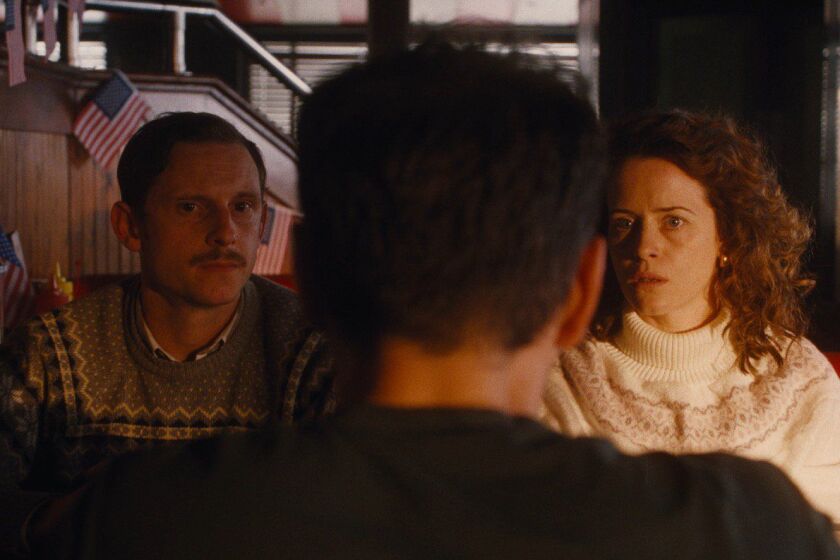
“I don’t like to visit set a lot, but I was right by the stage, and I was cutting the whole time,” Alberts said. “Andrew would drop in, and we’d talk about performance and what each of us was seeing a feeling. I’d drop in every morning and pop into his office as he was getting ready, and we’d chat about things, and then I’d go off to cut. [Director of photography] Jamie Ramsay would come by sometimes, too. And it’s very handy when you’re on set, and we’d all be asking ourselves: does this feel authentic? Does it feel good? Is something not feeling authentic? And if so, why?”
From initial idea to release, All of Us Strangers took about three years to come together. Being involved in more steps of the process than an editor normally allowed Alberts to offer useful creative input, but in the editing room, more discoveries awaited. “We experimented,” he said. “We didn’t restructure the film, but certain things came in and out. Some films completely restructure and change. Sitting with it for 12 to 14 months brought a huge understanding of some of the things that happened along the way. Some of them were just minute, whether it was a little bit of sound design or a piece of music. You never know when that stuff is actually going to arise, and I think if you have a shorter time to edit, you’re less able to discover things like that, these little gems along the way.”
Over the course of post-production, lots of smaller details were shifted. A scene where Adam (Andrew Scott) and his parents revisit memories, at one point included a jump-cutting montage, was removed for several months during the edit. “Oftentimes, you remove certain scenes to make things flow better, but then you might be missing an emotional beat or it feels too different, depending on the flow and the arc of that act. That’s not good. But those things happen all the time, and they happened in both big and small ways during [Strangers].”
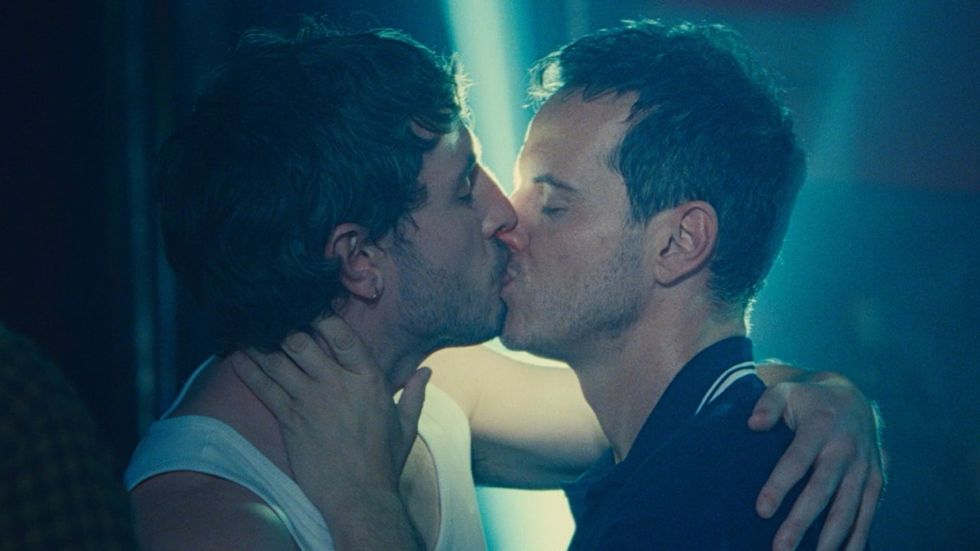
Another scene, in which Harry (Paul Mescal) appears when Adam is left alone in his parents’ bed, features a memorable piece of sound design where we hear car doors close and footsteps leading up to a doorbell ringing as the police come to the door in Adam’s memory. “The doorbell was this kind of thing that comes up over and over again in the film,” said Alberts, “and it was an interesting little motif that we ended up using to elevate and increase the tension. The doorbell becomes a bit of a terror later on when Adam wakes up on the subway.” That motif was not scripted, but discovered during the editing process, described by Alberts as “a happy accident [that took place] over a long time, that [we] spent so much time trying to dig out and excavate and understand. It’s an accident you have to work for.”
When asked about his favorite films, Alberts was at a bit of a loss. “I’m a big fan of [Abbas] Kiarostami [director of highly-regarded Iranian films such as Taste of Cherry, Close-Up, and Where Is the Friend’s House?] and [Krzysztof] Kieślowski [the accomplished Polish director behind the Three Colours trilogy].” Alberts also cited Mike Leigh’s Naked, Kieślowski’s Three Colours: Blue, and recent Academy Award nominee Jonathan Glazer’s Under the Skin as some of his favorites. “I like films that have stories about internal struggles. I always have. I’ve always loved trying to understand the interior of a character, which is part of the reason why I love Blue – it’s about a woman struggling to deal with her grief.”
Alberts brought up 45 Years, one of Haigh’s films, which is about a woman who is trying to understand herself in the context of her situation and her feelings. “I’m always attracted to those kinds of films,” he said. “Andrew [Haigh] introduced me to [Turkish director] Nuri Bilge Ceylan’s [2002 film] Distant, which is a fascinating story about loneliness and masculinity. I tend to be interested in films that have a lot of depth and substance and are attempting to say something. And I want something to say in terms of editorial style. That’s what I always go for, no matter the genre or tone. So that makes sense for me – the films that I tend to like often depict a sort of serious subject, the internal struggles of its characters.”
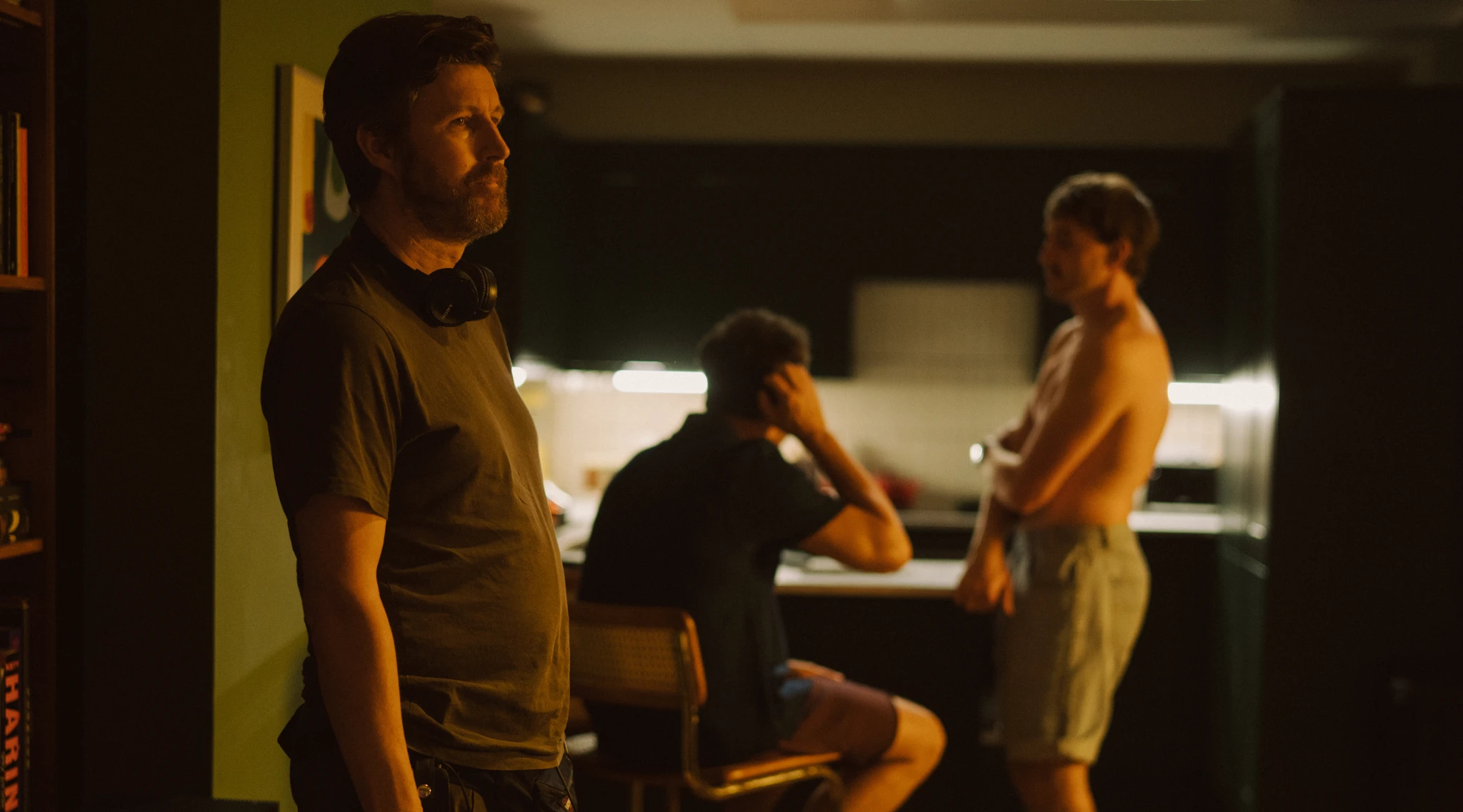
So, what’s next for Jonathan Alberts? Or, more interestingly – if he could work in any genre, what would he want to do? “Well, I like the sci-fi space,” he admitted. “I’ve worked on a sci-fi film [2015’s Equals], but I haven’t done a lot of it. I really like stuff like Children of Men, which is not one hundred percent sci-fi, but has that fantastical, dramatic side to it too.” Eternal Sunshine of the Spotless Mind was another one of Alberts’ comps. “I like apocalyptic stories like 28 Days Later, and I haven’t worked on one of those before. What I always end up coming back to is the human drama within those stories. That’s what excites me.”
All of Us Strangers is streaming on Hulu.

 Knock on Wood
Leave a comment