
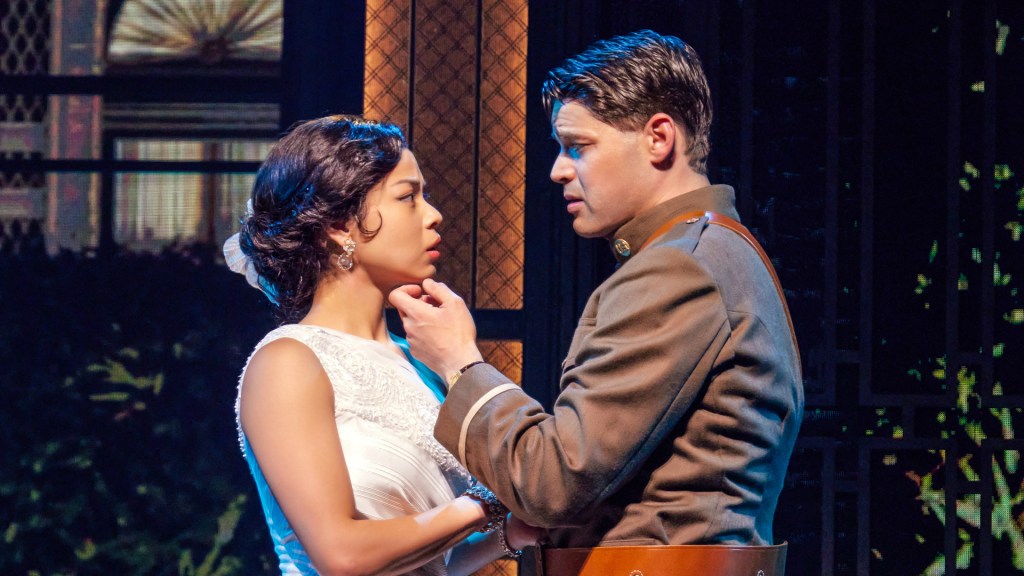
Even if you didn’t like it when you read it in high school, it’s hard to deny that The Great Gatsby is a culturally rich work of art. I read it in tenth grade, and have been marginally obsessed with it ever since. Like so many works of art that have entered the public domain, in 2021, Gatsby came back. And now the story has found its way to the Broadway stage.
A new version of Gatsby staged at the Broadway Theatre (try putting that into a search engine) officially opens this month, and it’s the latest of many adaptations of F. Scott Fitzgerald’s classic 1925 novel to grace the theatre. The music and lyrics were written by Jason Howland (Shucked) and Nathan Tysen (Tuck Everlasting), with a book by Kait Kerrigan (The Unauthorized Autobiography of Samantha Brown). As I settled into my seat, I was overcome with a rush of excitement looking at the sets; not only is the gilded Broadway Theatre the perfect place for a Gatsby production, but a massive crystalline chandelier hung over the seats, and the stage was practically painted gold.
One might assume that the lavishness of Broadway is the best place for a major Gatsby production. The story, which paints a sordid portrait of the ostentatiousness of the Jazz Age, demands the biggest staging possible to showcase the grandness of the time period while giving plenty of space for the intimate character moments, both of which are aplenty in this production.
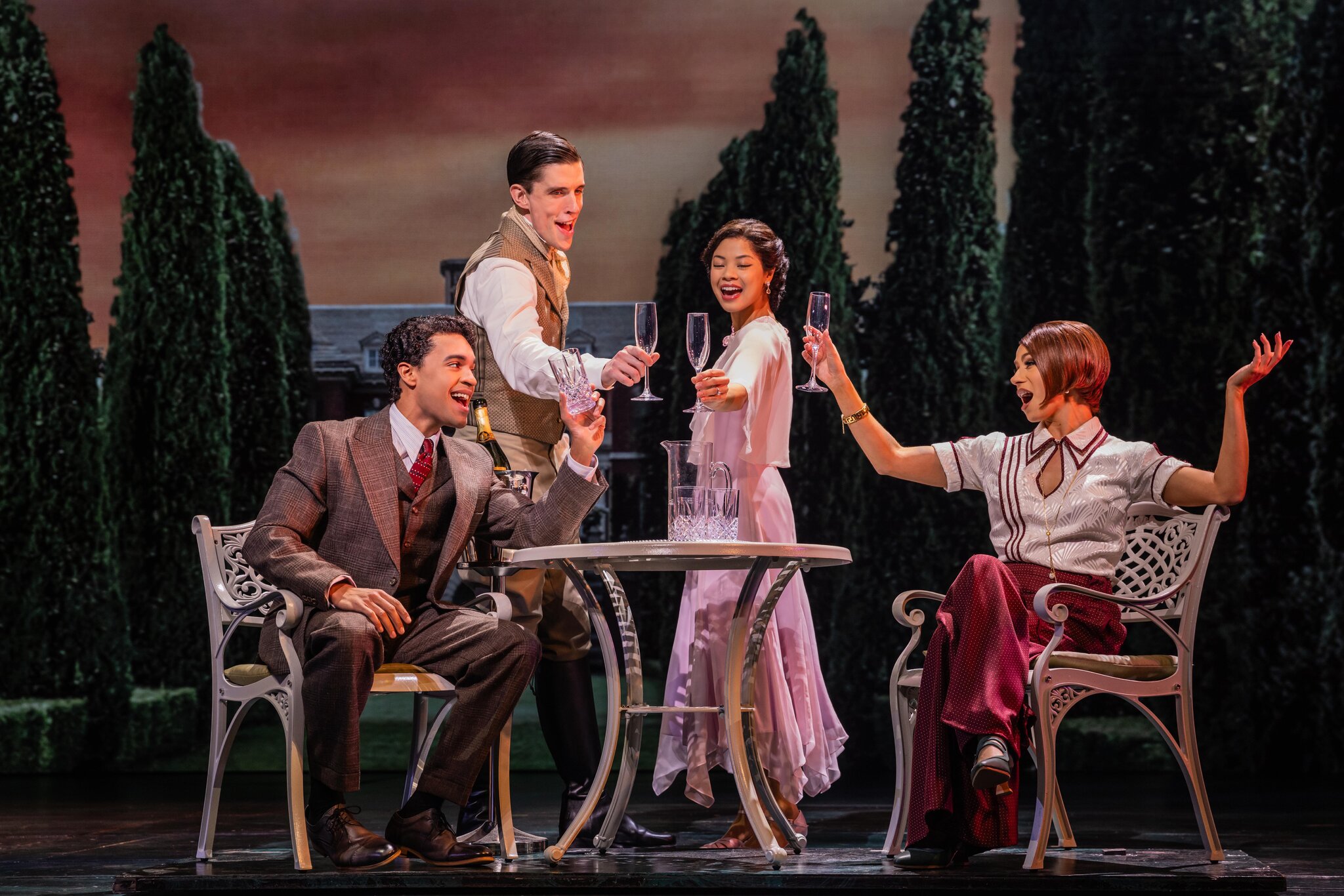
One of the first things that struck me was how well they captured the tone of the time and the feeling you get while reading about the fast-moving jazzy atmosphere of the 1920s. It was like they placed a camera in the head of my tenth-grade self and recorded his visualizations of what the loud, gold-plated world of Jay Gatsby looks like – the sets are constantly moving, but not distractingly so; flashy lighting is used sparingly, to further emphasize its effect when it is used; and everything moves. Even when everything is still, you feel the movement.
Nick Carraway, the unremarkable protagonist of our story, begins with his famous opening line from Fitzgerald’s novel: “In my younger and more vulnerable years, my father gave me some advice that I’ve been turning over in my mind ever since. Whenever you feel like criticizing anyone, he told me, just remember that all the people in this world haven’t had the advantages that you’ve had.” Thus, the road is laid and paved, and we’re ready to go.
If you’re not familiar with the story of The Great Gatsby, first of all – get on that! But more importantly, this Broadway iteration doesn’t hold your hand through the story. It assumes a base knowledge from its audience, and although it forges a path for itself in terms of its messaging and themes, it sticks to its guns and moves quite fast, not bothering to stop to explain or expand upon certain details that end up being key to the narrative.

The narrative itself is, of course, highly engaging – it’s one of the most iconic pieces of classic American literature, after all – but, as one would expect from a Broadway production, it’s far more streamlined than Fitzgerald’s already slim (but arguably dense) novel. Scenes are combined to excellent effect, unimportant details are removed or only mentioned in passing, and connections are made that weave the different ties of the story together in a way that befits a stage production. But the narrative adjustments are far from the show’s biggest issue.
In a whirlwind, we meet Nick’s outwardly delicate cousin Daisy (played by Eve Noblezada, who gained Broadway fame for her roles in Miss Saigon, Les Misérables, and Hadestown) and her brutish but wealthy husband Tom (John Zdrojeski), who is having an affair with Myrtle Wilson (Sara Chase), the wife of gas station owner George B. Wilson (Paul Whitty). Midway through the first act, Jay Gatsby makes his grand entrance, played this time by Jeremy Jordan, a modern theater legend with a resumé that includes Newsies, Waitress, Little Shop of Horrors, West Side Story, and many more. It’s an impressive cast, and perhaps the show’s biggest selling point, apart from the source material.
Yes, I liked this show…or, rather, I had fun with it, which is an important distinction to make. It’s exciting enough, and I came to it with a preconceived notion of enjoyment because of my initial Gatsby love, so I fear I may not be the best person to review this objectively, but if art is judged by human reaction, who are we if we can’t embrace our biases and analyze it with an intelligent and informed perspective?
That’s why I feel comfortable being a little more critical of this show, because a story like Gatsby demands the utmost care and precision throughout the adaptation process (I should know, I attempted to write, direct, and star in a gender-bent version set in a high school before the pandemic shut it down, and it definitely could have used about ten more drafts) and any half-baked result pales in comparison to the source material when the intention is for it to be a reinvention for a new generation.
Instead, Fitzgerald’s (excellent) dialogue from the book is sometimes clunkily jammed into the script, undoubtedly to elicit an “I recognize that line!” reaction from its audience, when many of the sentences don’t sound quite right when actually said out loud. Baz Luhrmann tried his best with his 2013 film adaptation, but the strangeness of the dialogue was more in line with his style as a director – this 2024 Broadway version very much plays everything straight, without a consistently defined style of direction. Say what you will about Luhrmann, at least he has a vision.
It’s not exactly productive to keep comparing adaptations, but it’s hard to silence those thoughts. Again, I’m saying all of this from a place of love – I would recommend this show to anyone who enjoys both Broadway musicals and/or has a fondness for The Great Gatsby; there is much to love on both fronts.
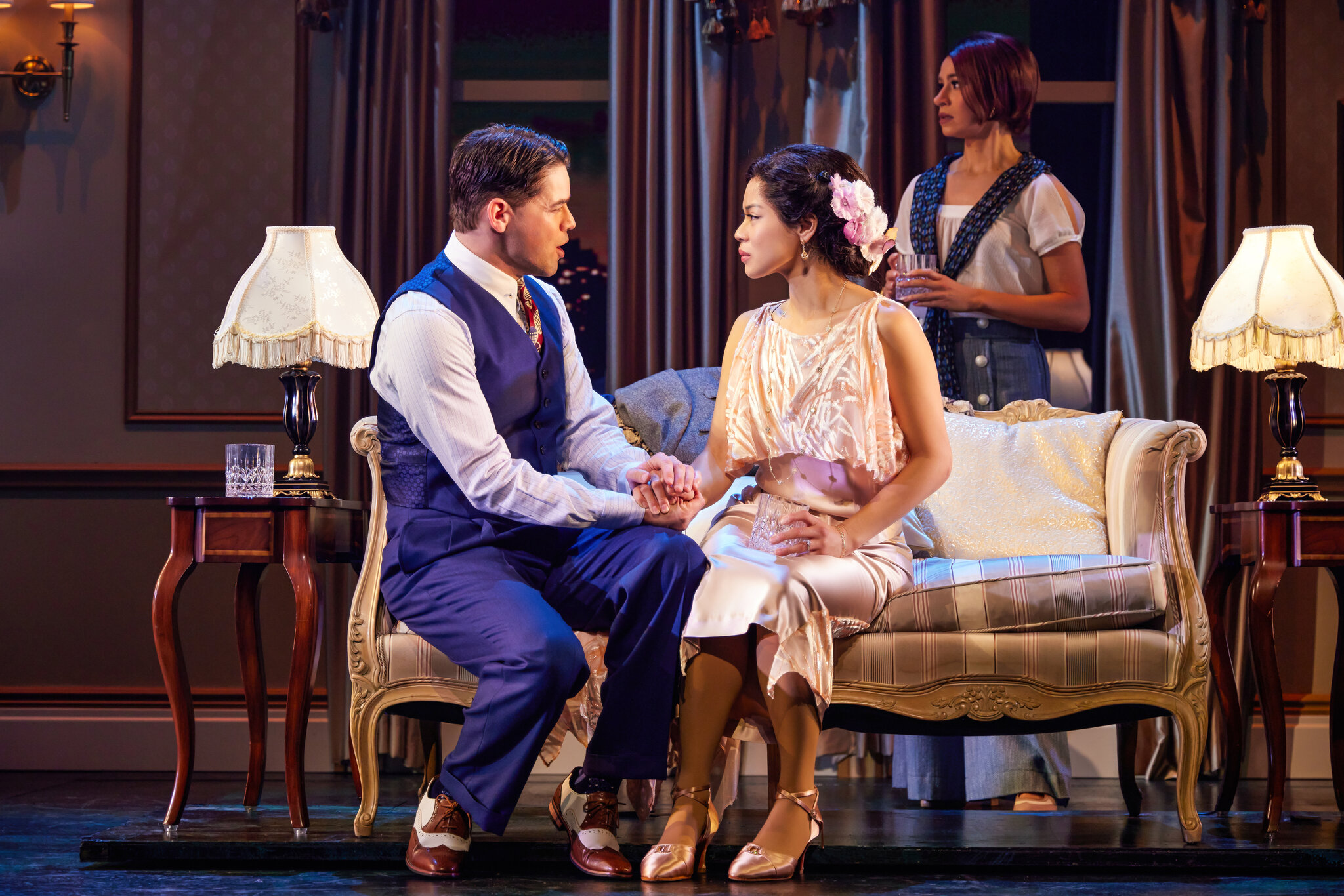
One of its biggest affronts is the character of Daisy Buchanan, which is sanded down to its most basic characteristics – a shame for one of the most interesting supporting characters of classic literature. By merging her iconic “beautiful little fool” speech into a song, not at the beginning but at the end of the musical, it reverses her characterization and leaves her in the place she should have begun. It’s worth reiterating that Eve Noblezada is innocent in this situation – her performance was one of my favorites of the entire well-cast company, and she perfectly embodies the Daisy in my tenth-grade head.
The Daisy choices are even more bizarre when it becomes more apparent that the show seems to have sacrificed her complexity to support a revamp of Jordan Baker (Samantha Pauly), who is admittedly boosted by a 21st-century perspective toward her overall involvement in the story. Jordan is far more interesting here than she has ever been before, and Pauly’s performance is invigorating, embodying the “devil may care” attitude of the Roaring Twenties in a fully-formed arc that ties nicely into Nick’s utter indecisiveness.
These reinterpretations are just safe enough to satisfy lovers of the novel and your standard theatre audience, but perhaps they’re a little too safe – after over a century, I feel like there’s a lot more that can be done with a story this iconic (I’m sure the public domain limitation had something to do with that), but if this Gatsby wants to stick close to the novel, that’s okay. At least it has the production budget to back it up.
I haven’t mentioned the music yet, and there’s a very good reason for that…and unfortunately, it’s that most of it was woefully unmemorable. There’s no cast recording album available to listen to, so there are no hard references I can make, but many of the songs are very conversational, substituting music for dialogue, and mostly without any conceivable reason. My theater companion, Kat, pointed out that Gatsby has a classic “I love her” song, but most of the songs are just “saying things with music” to other characters, constantly searching for a reason to burst into song to avoid long stretches without music. It feels pandering and, again, safe, not trusting the audience to stay engaged without constant singing. But who knows; maybe my feelings will change after the soundtrack is released.

A big reason the music didn’t work was that the show wasn’t even sure of its own themes…and if that’s the case, how are the songs supposed to back them up?
Anyone who has read it knows that The Great Gatsby is rich when it comes to themes and metaphors (perhaps a little too rich), and as someone who wrote several school papers about the aforementioned themes, I was certainly on the lookout when watching the show. It wasn’t long before I noticed that the musical only seemed interested in a surface-level approach to the themes, and somehow missed the point of many cornerstone metaphors the novel carefully maps out. Daisy’s mixed characterization is one such stumble, and I will admit I was hoping for a deeper dive into what gives the story its substance rather than a standard retelling with your typical Broadway flair.
Again…I did like this show. But maybe Gatsby just wasn’t meant to be a musical. This show makes a good (but not great) case for it. There’s another Gatsby musical, subtitled An American Myth, coming to the American Repertory Theatre in Cambridge this summer with music by Florence Welch (of Florence and the Machine) which looks to be a (more daring) new interpretation in line with Welch’s international soulful rock sensibilities. Apart from the fact that it will be exciting to see another stage adaptation of my favorite classic novel, it’s hilarious that there are two premiering in the same year – though given the quality of the book and lyrics, I wouldn’t be surprised if the current Broadway production was rushed to the stage to compete – but I’m excited to see how different they will be. If anything, the resurgence of interest in Gatsby only proves its timelessness, and affirms the fact that no matter how many centuries pass, someone will want to tell this story.
The Great Gatsby is in previews now at the Broadway Theatre. The official opening night is April 25.

 Knock on Wood
Leave a comment