

Civil War, the latest feature from writer/director Alex Garland, is perhaps a misnomer of a title. While the film takes place during a fictional near-future civil war in the United States, it doesn’t have much interest in engaging with the war itself, or its causes. Instead, it’s interested in the way a war like this would affect the people of the U.S. — in particular, it posits that there would be a disinterested reaction by the general public, despite the havoc being made plain to each and every citizen thanks to journalists (who have their own questionable motivations in the first place) putting their lives on the line to cover it.
An apolitical stance on a fictionalized American civil war is a bold choice, seeing as we’re at a point in time when a real one seems more likely than at any time in the last 160 years. The idea of war itself, and certainly a civil one, is inherently political, but Garland, whose films (and shows — respect to Devs) tend to explicitly skew more towards social commentary and technological existentialism within the sci-fi genre (Civil War is the first movie he’s written or directed that wouldn’t fall into that genre), opts to keep most of the politics unspoken. The U.S. president, as portrayed by Nick Offerman, in his rhetoric is similar to former President Donald Trump, with his grandiose — if almost completely fanciful — self-mythologizing and posturing. But to not be completely on the nose à la Don’t Look Up, he’s a more traditionally resolute and poised figure in front of the camera and behind a microphone while addressing the country. There’s an emptiness to him as a figure and as a person. Garland makes sure to highlight that this is his third term in office, to show that this isn’t some decent, just, Lincoln-like figure who just so happened to lose control of an already divided country.
Garland holds this attitude throughout the movie. Despite an Antifa name-drop here and a violent protest involving the police there, he doesn’t include many references to the topics that actually divide America today. There are no overt mentions of racism, sexual orientation, or gender identities, no conversations about abortion, no religious characters, and no discussions of class differences. But there is a heavy focus on the violence that war sews, the literal and metaphorical lens through which we view it, and the role of journalists in whatever unnamed divisions plague the fictional version of the nation.

The titular civil war mostly becomes a backdrop for Garland’s journalist road trip movie. Kirsten Dunst plays Lee, a hardened, desensitized photojournalist on the verge of a breakdown, whether she wants to admit it or not (she unsurprisingly nails the balance); Wagner Moura’s Joel gets a rush of adrenaline, and perhaps an increased libido, from going into active combat zones, and his mission is to get to the White House to interview the president; Stephen McKinley Henderson’s Sammy is the old guard of journalism who wants to make it to Charlottesville, where the Western Forces of Texas and California — the largest unified front against the U.S. government — are banding together to march on the White House; and Cailee Spaeny’s Jessie is a green 23-year-old who idolizes Lee, and wants to become a war photographer. This quartet of not-so-alike journalists bands together to journey from New York City to Washington D.C. with hopes of breaching the White House and interviewing the president. The specific ends of these means are sometimes unclear to the group — all they really know is that they want to get The Image and The Quote — but they’re going anyway.
Along the way, the group naturally has to make stops. The first is at a gas station where they have to negotiate a price for fuel in Canadian dollars, and where Lee and Jessie see that the station’s current proprietors have two men bloodied and hanging from their wrists out back. One of the said proprietors mockingly offers for Jessie to decide the men’s ultimate fate, and the fledgling photojournalist freezes, unable to answer or snap a picture of the brutality and incivility she apparently wishes to disseminate to the world. It’s definitely a fault of the movie that a moment like this mostly hits on an intellectual level — we hardly know enough about the character to feel for her in this moment, but it’s easy to grasp in theory why it’s difficult for a young reporter such as Jessie to fully reckon with what she’s seeing. That we feel anything for the character at all is due to Spaeny, who, after her turn as Priscilla Presley, conveys so much with her face — her terror at finally being confronted with what she purports to be seeking is written all over it.

Garland excels at this sort of visceral imagery from this point on, and while he doesn’t show you something you’ve never seen like Ava’s machine-human hybrid body in Ex Machina, everything in Annihilation’s The Shimmer, or *gestures to everything in Men,* Civil War’s images are naturalistically horrifying in a way that will stick with you. It’s an anti-war film in that he challenges you with violence, emphasizing the indifference with which the reporters and we view these kinds of images, both in the film and in real life. As the moving pictures of the film become the still photos taken by the protagonists, the injuries, pain, hatred, and death become immortalized — stripped of their context and easy to ignore for a time. We learn that Lee and Jessie’s parents live in Colorado and Missouri, respectively, staying out of the way and trying to ignore the conflict. To them, the photos are just photos, but as Garland argues when he brings his crew to a quaint town that seems stuck in the “before times,” where the war is known psychologically but not physically, the conflict is actually unavoidable.
In one of the film’s vaguely political ideas, the conflict also breeds factions of independent militants — the group encounters a sniper who is bunkered in their mansion, shooting at two soldiers who tell them that there are no distinct sides, just people trying to kill each other. In Jesse Plemons’ single scene as essentially a nationalist executioner digging a mass grave, presumably for those whom he deemed to be on the wrong side, we see the arbitrary, ruthless nature of violence.
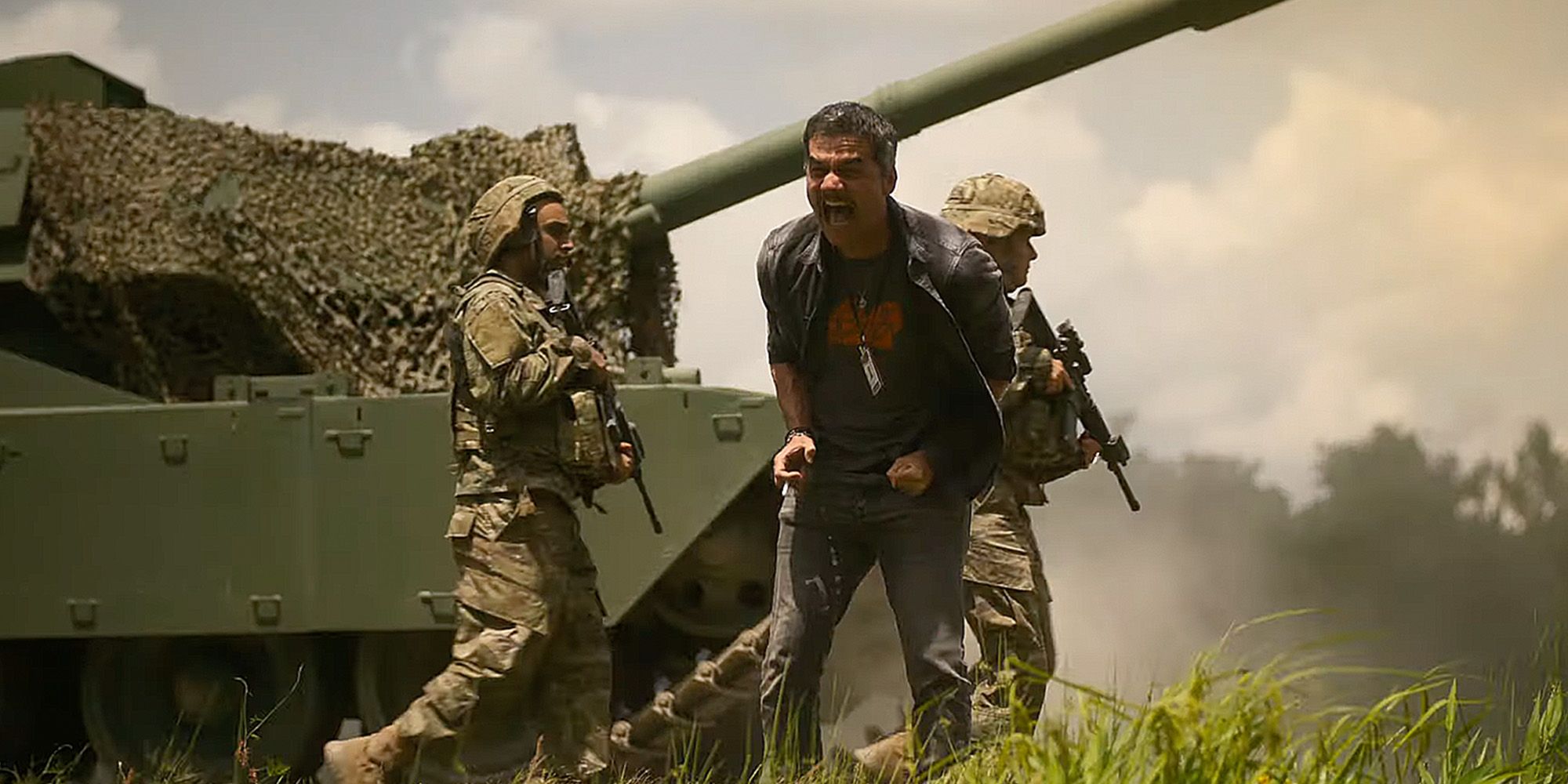
It’s clear that the one direct idea that Garland holds is that war is ghastly, and it breaks everyone’s brain: The journalists have a twisted relationship to it, a matter-of-fact one of apathy predicated on an unclear end; the everyday people just want to ignore it; and the more militant types take advantage of it, either for their gain, bloodlust, or some perverse combination of the two. Despite its assertive title and a marketing campaign that emphasizes action scenes in which a militia blows up the Lincoln Memorial, Civil War isn’t about our present cultural moment, but about a national attitude towards violence, and how it manifests in differently in different kinds of people. We’re numb towards real monstrosities in America because they don’t have the immediacy they might in other countries. So in making an admittedly hugely engaging movie that is made up mostly of tense, high-risk conversations, with an ever-present backdrop of carnage, Garland forces you to think about what you’re seeing. And with an ending that sees the characters come face-to-face with what they’ve wanted the whole time, their final actions send a clear message: We’re screwed and there’s no coming back.

 Knock on Wood
Leave a comment