

I’m convinced the showrunners of the world will not stop until every Founding Father has been given a miniseries on prestige television that details their actions during the American Revolution.
The latest in this odd but inevitable trend is Franklin, an eight-episode Apple TV+ series that stars Michael Douglas as the titular inventor, who played a major role in coordinating France’s aid in the Revolutionary War. The series covers the time that Franklin spent in France with his grandson, Temple, during those eight crucial years during the War.
The series obviously had a massive budget behind it, and all of the money is on the screen. Franklin is based on Stacy Schiff’s 2005 novel A Great Improvisation: Franklin, France, and the Birth of America, and you can tell that no expense was spared in bringing the Age of Enlightenment to the small screen with all of the bells, whistles, and gilded fabric necessary. In that way, Franklin is an immersive tale, and that’s the series’ biggest victory – enlivening the past with all of the shine and glamor you might expect from a big-budget period piece.

Unfortunately, where the series starts to fall apart is in its core concept; within the politics of the French monarchy and the endless swing of layers to the aristocracy is not the meaningful thematic resonance one might expect, but a history lesson instead. That’s not necessarily a bad thing, but there’s something to be said about a historical series that thinks very large of itself, only to falter at the point where the central historical events would be transposed for relevance in our society today. Instead, it’s a fairly straight shot in the educational arm, which is not bad, but it’s missing that vital step that could make it great.
Ironically, where the series does shine is during storylines featuring Franklin’s grandson Temple (which are sometimes at the forefront, and sometimes relegated to the B-story). Temple is played by Noah Jupe, whom I first saw in Wonder before his breakout role in the first two Quiet Place films, in what I would call his best performance if not for the sharp intensity required by the Quiet Place movies. In Franklin, Temple is the most well-rounded character, and as the audience surrogate, he adjusts to life in France and ends up assimilating even more thoroughly than his grandfather. He finds friends, learns about sex, and even becomes an ambassador to the court. A compelling coming-of-age arc is not what I expected from Franklin, but as a young person trying to find his own place in the world, I resonated with Temple’s story more than anything else the series had to offer.

Those who are hoping Franklin follows the lead of HBO’s John Adams miniseries will be sorely disappointed…although Adams himself is an important character in Franklin’s story. Here, he’s played by Eddie Marsan (The World’s End) and mostly acts as an antagonistic, self-righteous figure, who believes he has the primary authority to negotiate on behalf of the United States. Marsan is great, but his performance feels aimless, like many others in the show; I understand how these characters act, but not who they are and why they do what they do. Edward Bancroft (Daniel Mays) is a British informer in Franklin’s inner circle, but the betrayal is barely explored, apart from the initial reveal and a smattering of brief scenes in the following few episodes. The political intrigue that should be the most interesting element is at the mercy of not just the broad strokes of the history we know, but an overall failure to communicate why we should care about these characters beyond their place in the history books.
If Michael Douglas had sold his Ben Franklin better, the series might not have been as tough of a sell. Douglas doesn’t feel like he’s playing a distinct character, more so just putting on a fancy costume and a wig and being referred to by one of the most recognized names in American history. I have seen Douglas be phenomenal, but his turn as Franklin feels tame and uninspired. As the central figure in the show, most of it (bar most of the Temple story) rests on his shoulders, and he can’t bear the weight. Some of it has to do with the series often depicting Franklin as a passive character, gout-stricken and confined to a bed; neither the writing nor the caliber of acting can prop each other up enough to make the other more bearable.
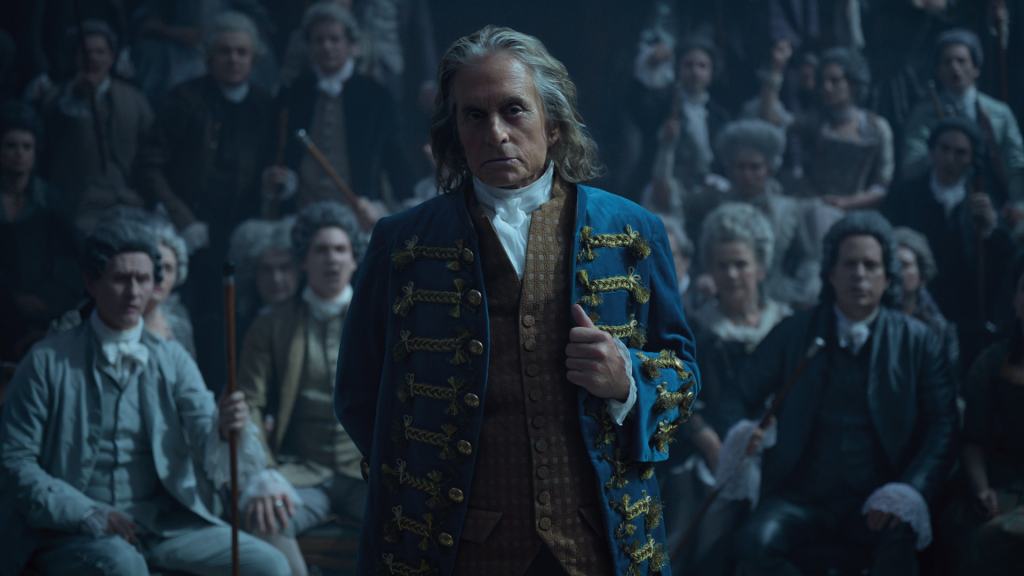
For all its faults, I actually enjoyed Franklin…for the most part. Despite not making too big of an impact, Douglas is charming, and the series smartly leans into (while not overdoing) Franklin’s reputation as a “ladies’ man.” After Hamilton took the world by storm, it’s exciting to see a different portrayal of the Marquis de La Fayette (Théodore Pellerin) – who begins as Temple’s friend Gilbert and eventually rises through the ranks of the United States military – that paints him as not only the confident and brash upstart history sees him as, but also as an optimistic young man who yearns for a brighter future.
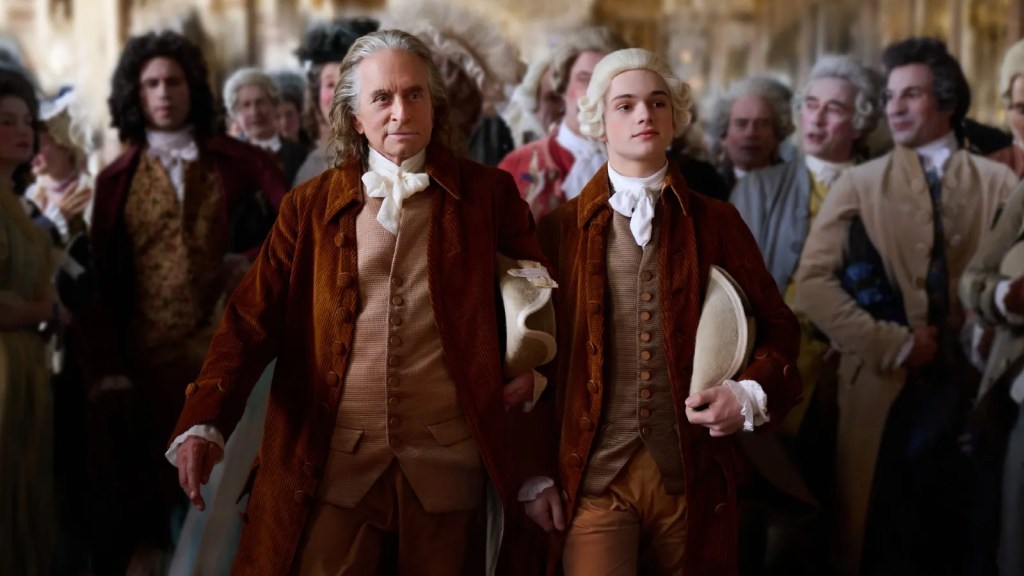
The politics of a show like Franklin should be a backdrop for further exploration, but I struggled to find deeper meaning. Maybe eight episodes is too short, but perhaps it’s also too long. The story could have worked as a film, though I have a feeling episodic television is the best medium to tell this particular part of Franklin’s story. But to paraphrase Cicero, a figure undoubtedly respected by Franklin, style should be avoided over substance every time. Franklin is fun on the surface, but there’s not much underneath.
Franklin is streaming on Apple TV+ now.

 Knock on Wood
Leave a comment