
This review contains non-graphic references to suicide. Proceed at your own risk.
A title is one of the hardest things for an artist to figure out. Sometimes, you might be lucky enough for the perfect title to pop into your head from the get-go, but it’s usually one of the last steps in the creative process, and it’s hardly ever easy. Hell, I tend to struggle with headlines for this very site. But there’s a certain art to the process when it comes to movie titles – not only should they pique the interest of an audience, but they should theoretically inspire that interest in most demographics, not just a devoted fanbase or a group that would have been interested in the film regardless. In that way, a film’s title is one of its most important aspects; it’s usually the first thing many people hear of, and can make or break the crucial audience interest.
This is a very loquacious way of saying that very few films truly nail the title. There are some that I love and admire, but the list of titles I love on their own is short. That’s part of the reason that Humanist Vampire Seeking Consenting Suicidal Person instantly grabbed my attention.
The French-Canadian production is exactly what it advertises itself to be, and I’m glad the title stood out to me when I chanced upon it on Letterboxd almost a full year ago. It told me everything I needed to know, and how many movies can you say that about?

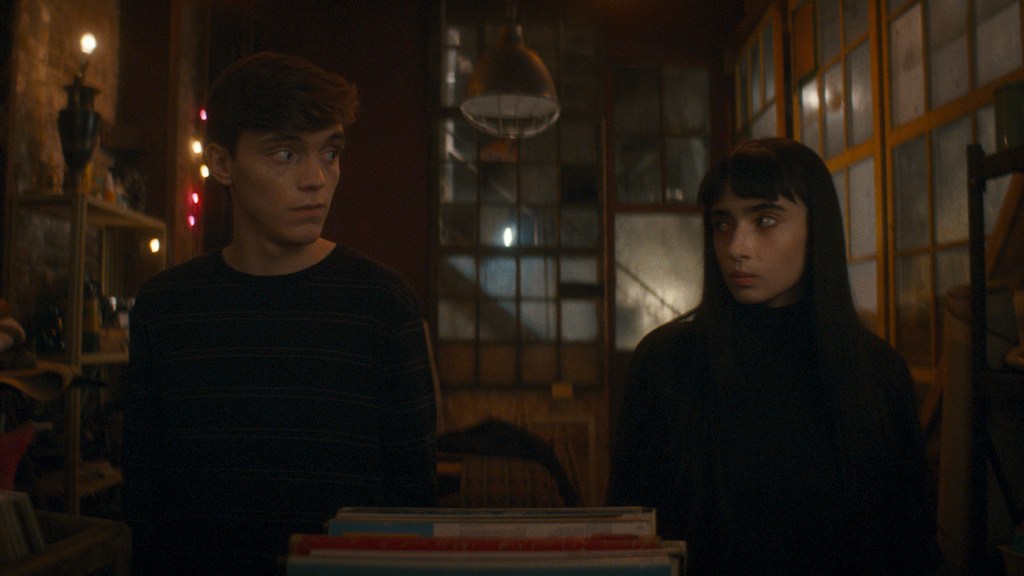
On top of a fantastic title, Humanist Vampire (the feature debut of director/co-writer Ariane Louis-Seize) also has a wonderfully attractive 92-minute runtime and a pleasantly simple premise. Sara Montpetit stars as Sasha, a teenage vampire (who is actually almost 70 years old), who does not subscribe to the ideology that keeps her species alive: her compassion, not hunger, is triggered by images of humans dying. Despite her unwillingness to kill, her family cuts off her blood supply, leading her to make a pact with depressed and suicidal schoolboy Paul (Félix-Antoine Bénard).
But despite the delicious tease of the film’s title, there’s a deliberate play on expectations – instead of a morose meditation on the inevitability of death, Humanist Vampire is a black comedy about morality and obligation that asks us to confront the systems we live our lives by. There’s still a hefty amount of confrontation when it comes to life and death, but much like our protagonist, it’s gentle and transactional – we contemplate our mortality, and in return we’re treated to a sweet story of friendship and existential longing.
One thing that Humanist Vampire does brilliantly fits right into my favorite non-genre – there’s no specific name for it yet, but it usually centers around fantastical characters and premises grounded in the reality we live in. Obviously, there’s no such thing as vampires, but what if there was? What would their domestic lives look like? What would their day-to-day experience and constant bloodlust be like in the context of our modern world? Humanist Vampire isn’t interested in diving deep into every question the audience might have, but it does convey its exposition artfully through the common knowledge of what vampires are, gathered through years of exposure through pop culture.
In the realm of vampiredom, the rules are different, but there are analogues to humanity; for example, Sasha’s reluctance to take human life (and the refusal of her fangs to cooperate) is portrayed as a disorder within the vampire world, and so she copes with music and instead feasts on blood bags, gathered either from a blood bank or from people killed by her parents. As a contrast, her older cousin Denise (Noémie O’Farrell) is heartily willing to kill, and tries on many occasions to throw Sasha into the deep end and force her to hunt for herself. This leads directly to one of the film’s only subplots, in which Denise has to deal with a layabout she accidentally turned into a vampire because of Sasha’s interference.

Sasha’s story is in direct parallel with Paul’s: like the young vampire, Paul is highly sensitive and very depressed. He’s bullied, both at school and at work, and no matter what he tries, he feels he can never do anything right. There’s an instant sense of sympathy for Paul, even though there’s no intentionality on the film’s side in terms of providing any sort of diagnosis or explanation for why he feels this way; it just is, and there’s no need to dive any deeper. The film itself is an exploration of both characters’ feelings and experiences, with their desires – Sasha’s, to spare innocent human lives, and Paul’s, to put himself out of his own misery – as the driving force for their arcs, which eventually intertwine and blossom as Sasha agrees to kill him after a night of fulfilling Paul’s dying wishes.
The question eventually becomes: Will Sasha go through with it? Will Paul still want to go through with it by the end of the night, and their delightful buddy comedy is at an end? From the onset, there’s an inevitable end point, but the fate of the misfits from different worlds always lingers. The tension is bolstered by the two central performances from Montpetit and Bénard, who make the most of what they’re given; there’s not a strong sense of character on the page, but Montpetit and Bénard bring them to life beautifully, and with an unexpected subtlety that makes them feel like real people rather than archetypes.
Humanist Vampire Seeking Consenting Suicidal Person is drab and dreary, because that’s how Sasha sees the world, but it’s also a charming indictment of obligation that perfectly appeals to my sensibilities as a genre fan. It’s slow, and not traditionally paced, but it’s a better vampire coming-of-age story than Twilight that mixes dark humor and bloody heartfelt bits to create an unconventional love story for the ages. Most importantly, it has a unique identity and strong production value that elevates it above your run-of-the-mill indie film.
Reject the horror of the world. Embrace the love.

 Knock on Wood
Leave a comment