

It’s fascinating to look back at the student films of directors who have since proven themselves as true industry talent – and it’s especially interesting to see how many of them explore concepts of voyeurism and observation. After all, when you’re working to master the camera, you have to be invested in how it interacts with the space inside, and with its subjects. This is especially apparent in John Carpenter’s USC short Captain Voyeur, but even more so with Martin Brest’s short Hot Dogs for Gauguin.
Martin Brest’s name might not be widely famous on its own merit, but the names of his films (which are comparatively few and far between) are much more well-known; after he made Hot Tomorrows, a feature film produced with AFI, Brest wrote and directed Going in Style, which would later be remade by Zach Braff in 2017. Brest would then go on to make Beverly Hills Cop, Midnight Run, Scent of a Woman (which made him a two-time Oscar nominee), Meet Joe Black, and then the career-killer Gigli, starring Ben Affleck and Jennifer Lopez.
He directed Hot Dogs for Gauguin while at NYU in 1972, and it’s not just notable because of who’s behind the camera. Danny DeVito (who would have his first starring role, in One Flew Over the Cuckoo’s Nest, just a few years later) stars as Adrian, a down-on-his-luck photographer who concocts a scheme to blow up the Statue of Liberty and take a photo at just the right moment in pursuit of fortune and fame.
DeVito’s future wife Rhea Perlman makes a cameo as a woman on a ferry, alongside Brest’s on-screen cameo as the man beside her. Brest was inspired by one of the most iconic photographs in history: the one that captured the Hindenburg disaster in 1937, a photo directly incorporated into the short film’s story – it’s Adrian’s inspiration for his explosive plot. William Duff-Griffin (who would later be featured in Basic Instinct and The Hudsucker Proxy) also appears as Adrian’s Shakespearean scholar friend Fletcher, who mainly acts as a sounding board, and later opposition to, Adrian’s plan.
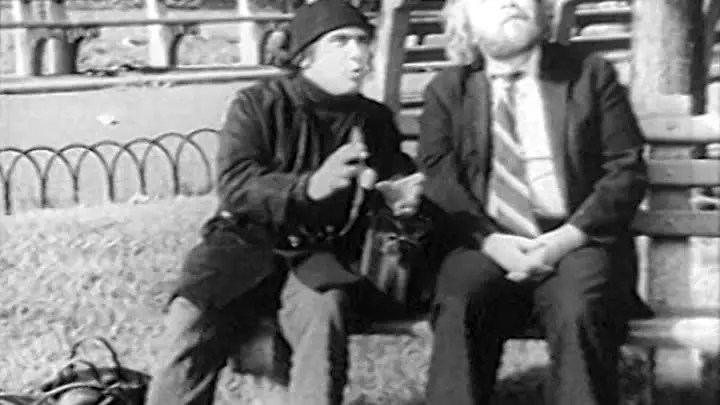
Not many people have seen Hot Dogs for Gauguin – in fact, until recently, it was thought to be mostly lost, until it was unearthed, digitized, and posted on The Cave of Forgotten Films. It can be seen there in its entirety, albeit in a rather rough transfer; but that’s probably the best quality one can hope for given the circumstances. It’s an easy watch at 22 minutes, and incredibly fun to watch DeVito act his ass off in one of his first on-screen roles. From a filmmaking perspective, it’s very well put together (which makes sense – Brest is a noted perfectionist), but it’s only a hint at the mastery that Brest will come to have over the language of cinema.
The biggest scene comes at the very end of the short – spoilers incoming, I suppose? – as Adrian is distracted at the last second when the explosion finally happens. In a shot that must have been done via miniature or model, the explosives that Adrian planted inside the statue’s nose explode and take the statue’s whole head off. It’s an impressive and flawlessly executed show of special effects, pulled off by Brest and VFX supervisor Randolph Herr. Having missed his chance, and wasted his go at domestic terrorism, Adrian slinks back down to the street, back to square one.
Examining the origins of our favorite filmmakers can be surprising, but it can also be validating. Hot Dogs for Gauguin proves that Martin Brest has always had an eye for what makes great cinema, but also, refreshingly, he was at one point fallible and imperfect (let’s ignore the Gigli of it all). Hot Dogs for Gauguin is a very good student film, but it is still a student film, and a valuable one to look back on as a stepping stone in a progressively beguiling career.
Hot Dogs for Gauguin is available to stream on the Cave of Forgotten Films website.

 Knock on Wood
Leave a comment