
Yorgos Lanthimos’ first English language film was The Lobster, a fairly inaccessible movie due to its dry dialogue and odd subject matter. His follow-up was The Killing of a Sacred Deer, in which he reunited with Efthymis Filippou, his screenwriting partner from Dogtooth, The Lobster, and Alps. Sacred Deer and Dogtooth are both pretty mean-spirited while including the same dry, stilted performances and black comedy as The Lobster. The Favourite, the first of Lanthimos’ now four collaborations with Emma Stone (with more to come), was his most accessible film up to that point, featuring still over-the-top characters who now had a more relatable sense of humanity. While it won Stone her second Oscar, Poor Things abandoned almost all of Lanthimos’ trademark nihilism — it has a playful quirkiness to it that revels in the joy of life. So while Lanthimos has never made a movie with characters who feel like you might encounter them in real life, he was certainly trending in a more humanist direction for a while.
But that was before Kinds of Kindness.
Kinds of Kindness is a synthesis of the different modes Lanthimos has operated since Dogtooth. The characters are more relatable in their motivations and behavior, but it has such a matter-of-factly bleak tone that it becomes all the more jarring. If it seemed Lanthimos’ career was a slow evolution towards silliness and optimism, Kinds of Kindness shows that was all front, or at least that Poor Things (and to an extent, The Favourite) were a detour in an otherwise consistent filmography. His reunion with Filippou shows Lanthimos wants his films to get back to what coincidentally works best for me about his filmmaking style and language: the acknowledgment that there’s inherent absurdity to the natural depravity behind our desire for control, and to be controlled.
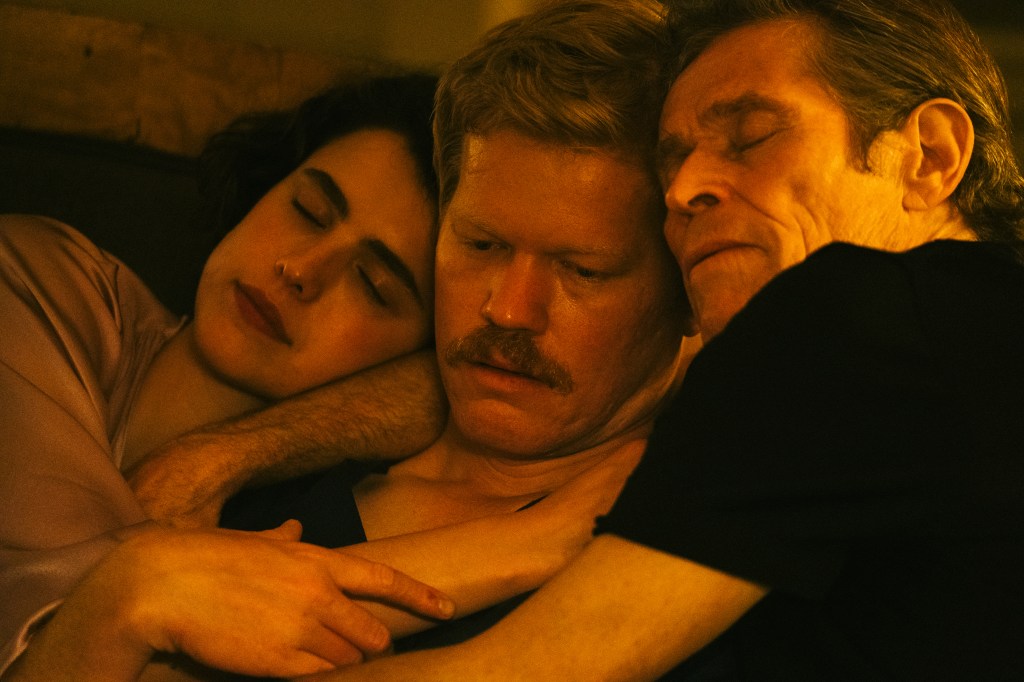
The film explores this idea in three parts. It’s an anthology in which all three stories circle the same concepts and star largely the same actors. So we get three stories that are so alike in form, performance, and tone that you’d be forgiven for not being able to distinguish between them, apart from brief credits separating them and the similar set of actors going by different names. It’s as if Lanthimos and Filippou wrote themselves into a thematic corner, decided to reset, and reached the same conclusion three times, throwing their hands up the third and conceding this is what they wanted to say: We want to be in control, but we also want someone to give us direction. There’s a thin line between the two, yet it yields massively different types of lives and people, and truly being in control is reserved for the wealthy and powerful.
In the first part, “The Death of R.M.F.,” Robert (Jesse Plemons) is a businessman who does whatever his boss, Raymond (Willem Dafoe), tells him, including consequential things, like getting into a car crash with the intention of killing the other driver, or not having kids, and smaller things, like what drink to order at the bar. In exchange for these services, Raymond sets up a wonderful life for Robert, including a beautiful house, a lovely wife (Hong Chau), and valuable trinkets such as one of John McEnroe’s famous crushed tennis rackets. When Robert refuses an order, though, he falls out of Raymond’s good graces, and essentially can no longer function without being told what to do.
The second part, “R.M.F. is Flying,” follows Daniel (Plemons), a police officer whose wife, Liz (Stone) is lost at sea. He takes solace in the presence of his partner and friend, Neil (Mamoudou Athie), and Neil’s wife, Martha (Margaret Qualley), with whom Daniel and Liz have previously had a seemingly polyamorous relationship. When Liz is found, she doesn’t quite act like herself, and Daniel thinks something is amiss — he goes to drastic measures to prove to his friends that his wife isn’t who she says she is.
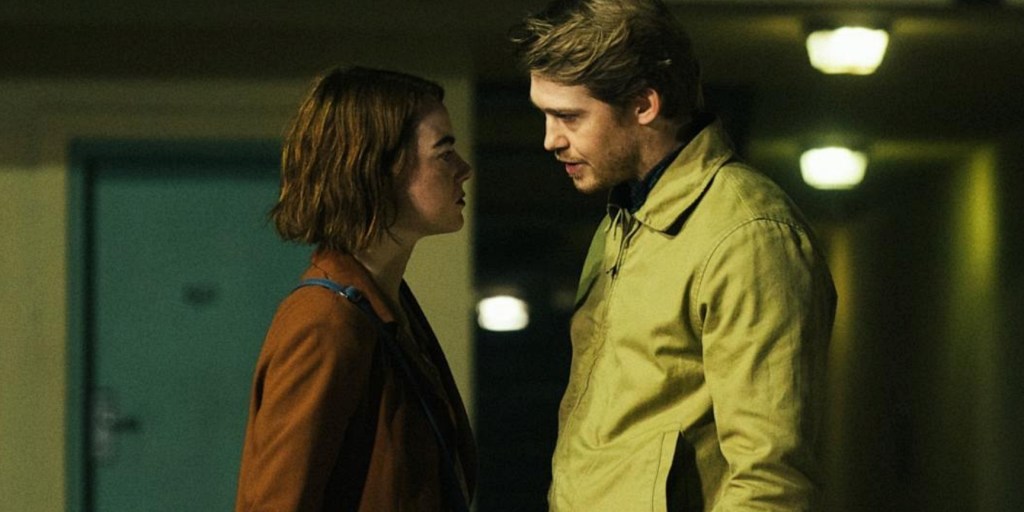
And in “R.M.F. Eats a Sandwich,” Andrew (Plemons) and Emily (Stone) are cult members looking for their messiah — in this case, she is thought to be a young woman who can reanimate the dead. To remain in the cult, they must cut themselves off from their previous life, but Emily is (understandably) drawn to her husband (Joe Alwyn) and daughter. When the cult leader, Omi (Dafoe), finds out what Emily has been doing, he kicks her out, prompting Emily to go rogue to achieve reentry into the cult.

All three of these parts, while vastly different in plot, carry almost identical tones, hence the near inability to distinguish between them. Forget the energy of the film’s incredible teaser — you’re in for something devoid of propulsiveness, but full of intrigue and a unique brand of camp. Twice, the film uses a piano score that only seems to be fitting for a corporate inspirational training video, but it’s behind characters baring their souls. It’s this sort of tongue-in-cheek filmmaking line that Lanthimos walks so perfectly. The world is farcical to him, and that’s why a dry, dark, wittiness is the only way he can portray humanity (apart from the outlier that is Poor Things).
The first and third parts work excellently, and the point is clear each time — in the contrasting moments of Plemons ordering at a bar in “Death,” and Stone seeing her family in “Sandwich,” lies the central theme of control and desire. Why is it so difficult for Robert to come up with his own drink order? Why does Emily not simply go home to her family that clearly loves her? Because making our own choices can be terrifying. Though most of us would purport to want our own sense of control and independence, taking away the safety net of someone else constantly making decisions for you is worse than the desire to be with your family or have your favorite drink. Submitting to something bigger than yourself — often an institution of some kind — while it will likely cause pain and harm to others, is the most direct path to the easiest life.
It’s a bit murkier trying to find a central idea in “Flying” — both thematically and narratively — but it’s still compelling enough to keep you guessing. All three parts share that trademark warped, dry reality of a Lanthimos movie, but their disaffected humor shines through most of his films, apart from Poor Things. A particular shocking sight gag in “Flying” is most emblematic of this — it’s as close to a straight-up comedy as you’ll get when Lanthimos is operating in this space.
The “R.M.F.” in the title of each part is a character who we meet in “Death,” and the only character to keep the same identity throughout the whole film (he’s played by Yorgos Stefanakos). He’s tertiary at best to the main plot of each section but is central to the stories. He’s the man to be killed in the crash in “Death,” the pilot of the helicopter that rescues Liz in “Flying,” and a dead body to be resurrected in “Sandwich.” R.M.F.’s fate or involvement is always at the behest of our main troupe. He’s someone to be controlled, or who’s in control at consequential moments. Operating as a sort of Everyman to our own Main Character Syndrome, he hammers home the constant tension between the need to control and to be controlled. The different kinds of kindness that the film portrays are of course not kindness at all — our fundamental desire to be controlled contorts the concept of kindness up to the point that it’s hardly recognizable as such.

Lanthimos’s singular atmosphere, though, would of course be nothing without his players. On top of Plemons, Stone, Dafoe, Qualley, Chau, and Athie, Alwyn and Hunter Schafer are also involved to varying degrees, and they all fit perfectly into the tone. But though this is essentially an ensemble piece, it’s really Plemons’ movie. His typical affectation nicely slides into a Lanthimos vehicle, but he brings an inherent, underlying humanity to the stiltedness in a way Colin Farrell (Lobster, Sacred Deer) or Stone (Favourite, Poor Things) never quite have. Farrell and Stone have never been asked to bring that humanity, but that’s what makes Kinds of Kindness different in the Lanthimos pantheon. The characters feel like real people on a certain level, but still live unforgivingly in an unforgiving world, every last one of them.
Kinds of Kindness is playing in select theaters now.

 Knock on Wood
Leave a comment