
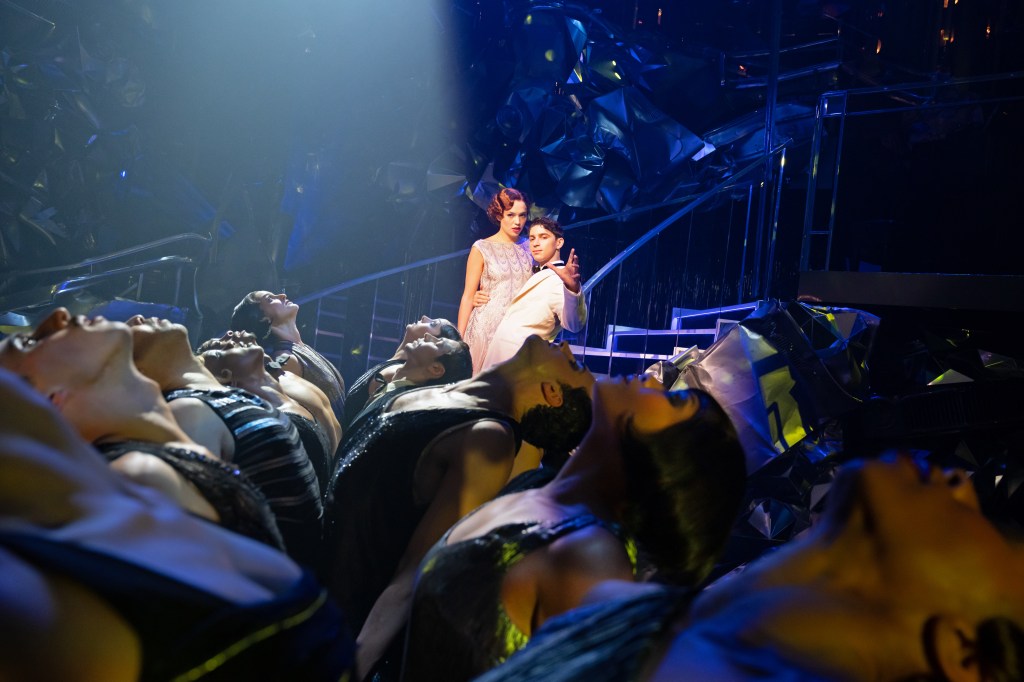
In April of this year, I saw a Broadway-bound adaptation of F. Scott Fitzgerald’s The Great Gatsby (one of my favorite classic novels), but noted that it seemed rushed to avoid competition with another musical Gatsby, this one spearheaded by Florence Welch, lead singer of Florence + the Machine. I was glad to hear that Welch’s Gatsby (subtitled An American Myth) was taking its time, forsaking the crucial Broadway spring premiere window in favor of a nicely-timed debut at the American Repertory Theater in Cambridge, Massachusetts.
Those familiar with Welch’s music know her penchant for poetry and abstract metaphor, focusing on the romanticism, joys, and strife of the human condition. Her footprint on this show is massive – the character of Daisy even sings in Welch’s vocal pattern, as if designed for Welch to step in if necessary – and her involvement is the chief factor that elevates this version of the story. The tale of Gatsby is haunting and sad, not glamorous or desirable, and this show fundamentally understands that it is a tragedy.
Its subtitle is, in a way, perfect for what the story is – Fitzgerald’s novel is chock-full of symbolism (which I wrote about many times in my high school English class) because it’s a myth, a fable, a warning about the American Dream and how it can so easily consume the hopes and aspirations of good people. Welch and playwright Martyna Majok (who won the Pulitzer Prize for Cost of Living) understand that completely, and so their show is a somber one, but it’s as aligned with Fitzgerald’s original intentions as any other adaptation thus far has been.
Isaac Cole Powell plays the titular Gatsby as a confidence man, desperately trying to hide the darker parts of himself inside the gilded shell of a millionaire best known for his extravagant parties. He’s at the center of the complex narrative, but the character is the most straightforward – I would argue Gatsby’s next-door neighbor Nick Carraway (the famously unreliable narrator, played here by Ben Levi Ross), Nick’s cousin Daisy Buchanan (Charlotte MacInnes), and her abrasive husband Tom (Cory Jeacoma) are far more nuanced, but Gatsby remains the story’s most interesting figure. Powell’s Gatsby is a deeply sad individual, projecting a façade to the outside world in the name of chasing a dream that will never come to fruition. He’s teased in the first section of the show’s first act, seen on-stage only in shadow, allowing the mystique to build before a casual introduction at the first act midpoint.

Ross is also excellent, portraying Nick with the earnest confusion the character warrants. He’s the narrator first and foremost, and an active part in the story…to a point. Eventually, he becomes passive (and very intentionally so), but his perspective on the situation is so crucial that his place in the narrative is cemented. It’s harder to maintain the guise of an “unreliable narrator” on the stage (especially since some musical numbers are directly from the point of view of other characters, like Daisy and Tom’s mistress, Myrtle), but Gatsby threads the needle well, ensuring Nick’s occasional interjections keep the story on the necessary track.
It speaks to the strength of the show that MacInnes is one of its weakest links, and her performance is a powerhouse unto itself that works far better in isolation than it does as part of a larger whole. MacInnes paints Daisy as melancholic and shallow, but only manages to firmly pin down one dimension of the many that Daisy has in the novel. Matthew Amira, who plays Myrtle’s mechanic husband George Wilson, is another player that didn’t quite blow me away, but his scene partner (Myrtle actress Solea Pfeiffer) is so magnificent that their scenes together are spectacular regardless.
What I found most interesting was where Gatsby: An American Myth’s priorities lay. It’s hard to judge the characters from the source material alone, because it’s so dense and layered with the aforementioned symbolism (I say this lovingly, as a huge fan of Fitzgerald’s novel), but there’s a heavier focus on Myrtle and Wilson’s situation, and less emphasis on Nick’s inner monologue. His asides to the audience are more expository, giving the show more room to focus on the broken promise of the American Dream, which affects each and every character in a different way. The divide between the rich and poor (embodied by the opposite perspectives of Gatsby and the Wilsons) is also a strong element, but my favorite focus is the pronounced queerness only danced around and implied in Fitzgerald’s novel – here, Nick Carraway is explicitly queer, and although his esteem and feelings about Gatsby aren’t crystallized, it’s refreshing to see queerness and sexuality portrayed so unashamedly. It’s about time we had a Gatsby adaptation that wasn’t afraid to embrace what we all knew to be true.
Welch’s songs (co-written with Thomas Bartlett) range from ponderous to heartbreaking to catchy, sometime encompassing all three within a single tune. Welch’s lyrics are brilliant and profound, taking a classic story already so layered and metaphorical and elevating its strongest ideas into musical masterpieces. I find myself disappointed there’s no cast recording album, and I can’t listen to my favorites over and over again.
It should be stated that Gatsby is a ridiculously hard story to get right on the page, much less stage effectively, and getting its core messages across is no easy task. Some of the nuance and detail from the novel is bound to fall to the wayside, but An American Myth makes up for it by introducing key details and information unique to the show that play better on stage; not to mention that a visual medium is always best to showcase countless iconic bits of symbolism, including the infamous “Eyes of T. J. Eckleburg,” of course a metaphor for the eyes of God’s judgment. It’s one of many things that make An American Myth the best adaptation of The Great Gatsby so far (I also find it notable that the first two words – The Great – are removed from the title). There are definitely choices I didn’t agree with, but the experience was so overwhelmingly positive that I come away giddy and happy that one of my favorite pieces of prose finally got the adaptation it deserves.
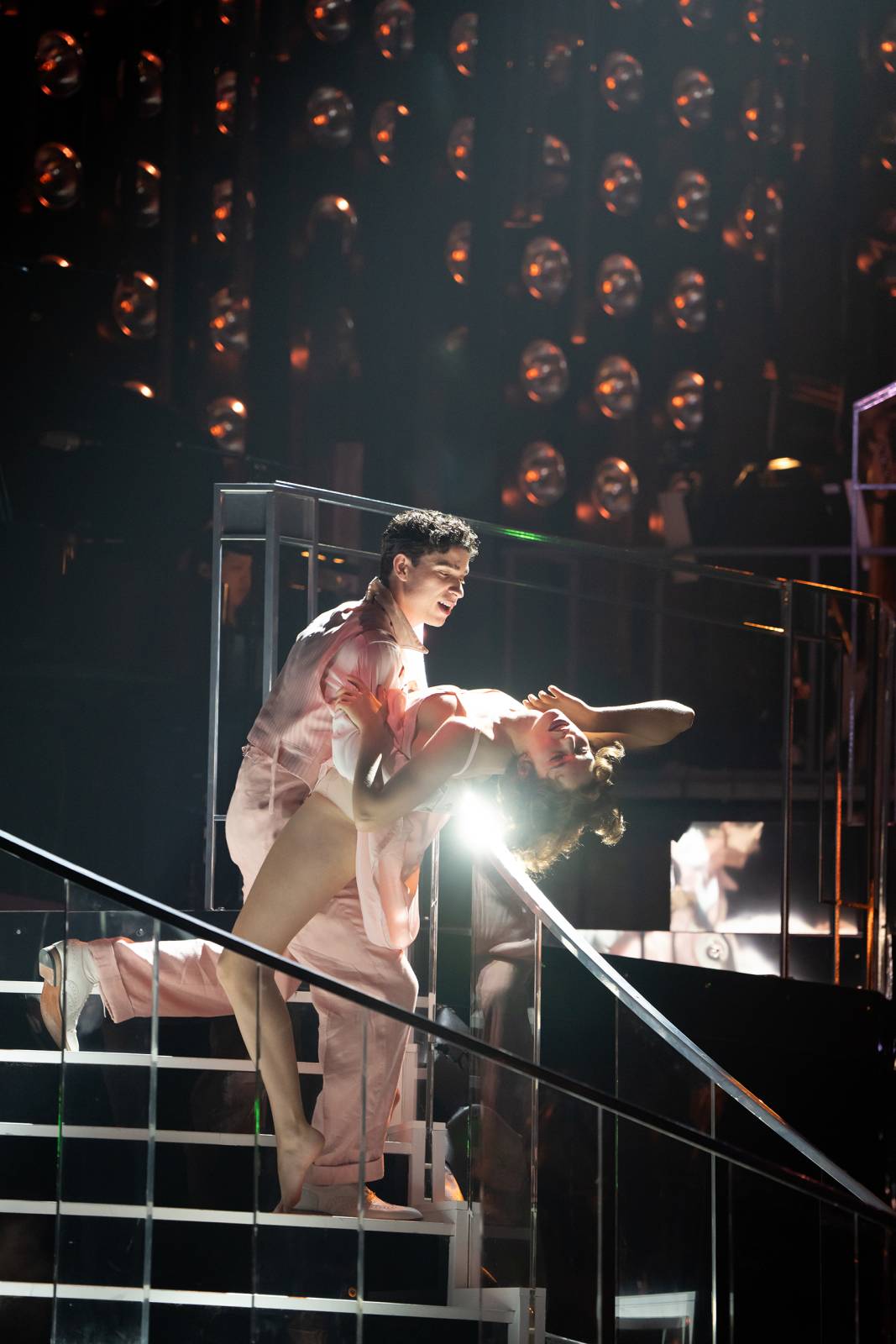
In the show’s press release, Welch was quoted as saying “This book has haunted me for a large part of my life. It contains some of my favourite lines in literature. Musicals were my first love, and I feel a deep connection to Fitzgerald’s broken romanticism.” Her voice is perfect for the somber wistfulness of Gatsby, and I feel privileged to have experienced it with my own eyes and ears. Now let’s get it to Broadway, and let the Gatsbys fight!
Gatsby: An American Myth is playing at the Loeb Drama Center in Cambridge through August 3.

 Knock on Wood
Leave a comment