
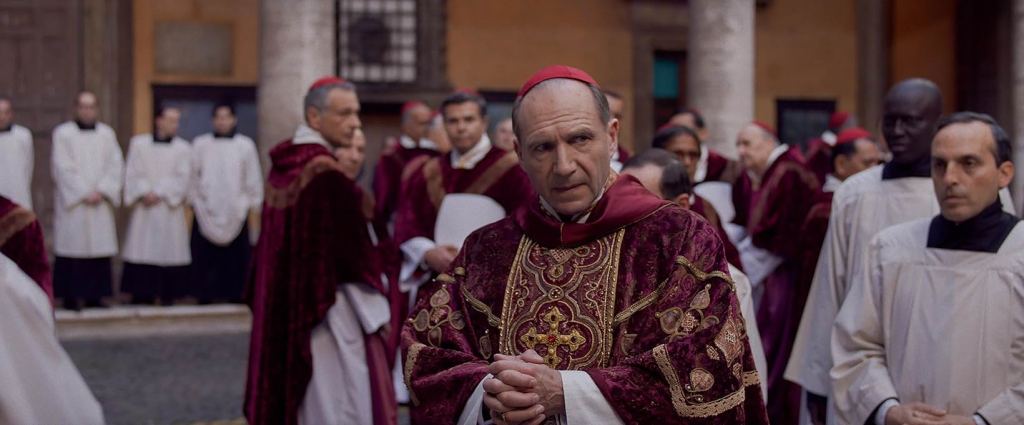
To say that the Roman Catholic Church has been steeped in controversy throughout its history is possibly one of the greatest understatements of all time. Controversy and the Church, for better or worse, go hand-in-hand. Transparently, I myself am a lapsed Catholic largely due to all the scandals in my lifetime, among other reasons. In fact, controversy is so common with the Church that it’s been covered in high-profile, award-winning films many times before, a recent example being the Best Picture-winning Spotlight from not even a decade ago. So with the release of Conclave, another film regarding the politics of the Catholic Church and all the controversy that it entails, is it even worth taking notice of, or is this just standard procedure at this point?
Absolutely, and unequivocally, yes. Conclave is damn well worth your time and attention. In fact, it’s one of the greatest pictures of the year.
In a vacuum, this film follows all the Cardinals in the Roman Catholic Church as they deliberate on who should be the new pope, as the previous pope has recently passed away. Outside of that vacuum, this is a film about the unquenchable hunger of man’s ambition that corrupts and rots from within. But it’s also about the reluctance and doubt spawned from man’s folly that humanizes us so we gain understanding, allowing us to fight back against corrosion. It is about the dangers of certainty, and trying to force outdated and pragmatic dogma onto people, instead of remaining open to the uncertainty of progress in humanity’s ever-changing landscape. And it is fascinating.
It’s no mistake that this was released the same year as one of the most pivotal elections in human history. It’s no mistake that the themes of this movie transcend the film’s narrative structure to illustrate the dynamics of politics beyond the confines of the Church. More than anything, it’s no mistake that the final minutes of this film show us how even the most progressive can still be caught off guard by our preconceptions. That we can all grow in support and love.
Now, a film that achieves all of this, while making us examine our own morality as it pertains to righteous indignation, is already impressive. The themes alone would easily push me to see such a film. But it’s the fact that Conclave accomplishes this, while simultaneously playing out like a high-stakes game of Survivor, that makes this so entertaining. It’s House of Cards. It’s Game of Thrones. It’s a film about political machinations and selfish motivations, with the papacy itself standing tall as the final prize. And that gamesmanship is damn fun to follow. Who’s voting for who, who has leverage over someone else, what twists and turns in the gameplay will matter, and who will eventually win in the end? It’s riveting to follow.
A walk-and-talk script from Peter Straughan of Tinker Tailor Soldier Spy fame gets the blood pumping. Though it’s never as strong as an Aaron Sorkin script, especially in the dialogue, it’s very clearly evoking that style. What Straughan does accomplish is a strong sense of character as we are inundated with over half a dozen distinct personalities to keep track of who they are and what their motivations may be, and it’s never overwhelming. This is helped, of course, by Edward Berger’s presence in the director’s chair. Using a lot of the framing devices and pacing templates he formulated in his version of All Quiet on the Western Front two years ago, Berger transforms this Straughan script into next-level storytelling. It becomes relentlessly captivating as we dive into these complex characters, their pasts, their actions, and how all of these choices impact the voting for a new pope. It’s riveting from the word go.
Another big contributing factor to the intensity and entertaining energy of the film is that of Volker Bertelsmann’s score. A much better composition of music compared to the irritating work in All Quiet that egregiously won Best Score over the far more deserving Babylon, here Bertelsmann puts together a brilliant collection of music that enhances Conclave in almost every way. It’s like a clock, ticking down the patience of our characters, churning momentum through the story, and building anticipation in the audience towards inevitable explosions. Easily one of the best musical pieces of the year so far.
Now, it’s worth noting that there is a shift in tone as we enter the third act of this film. It’s not a large shift, but it is there. This is due to the movie largely living in a heightened sense of reality through the majority of its runtime, only for the last thirty minutes or so to get so serious and grounded that it could be off-putting. Additionally, there’s a reveal in the closing minutes of Conclave that simply won’t work for everyone. It will be too out of left field. Too random, with too much weight beyond it, without the proper setup to fully execute on its progressive messaging. Personally, I disagree. In fact, I think the final few minutes of this film go a long way in achieving all this film wants to accomplish. I found it resonating and beautiful, but not everyone is me. Not everyone will fall head-over-heels for this ending.
Arguably the biggest factor as to why this film is so successful, outside of the tremendous thematic work as it relates to the narrative, is because of the incredible performances. And I mean this in both an individual sense as well as an overall ensemble performance.
Ralph Fiennes is fantastic as our lead. His character is written such that he remains a largely neutral figure who’s steeped in expositional procedure, allowing him to be a tremendous audience surrogate for this experience. And he does not waste the opportunity to be profound. Though he is mostly quite reserved, Fiennes is still granted numerous opportunities to dazzle with his range, providing numerous moments in which he elevates the material and scene he’s in.
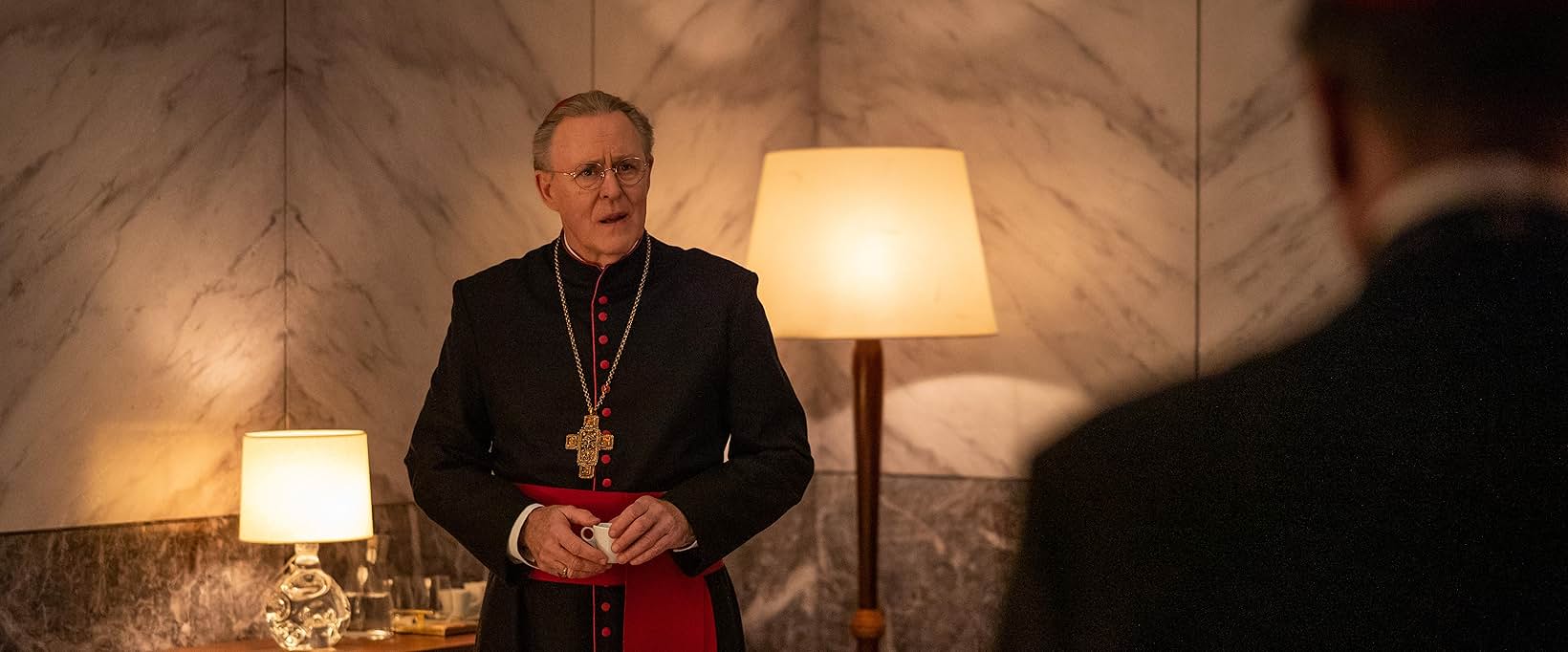
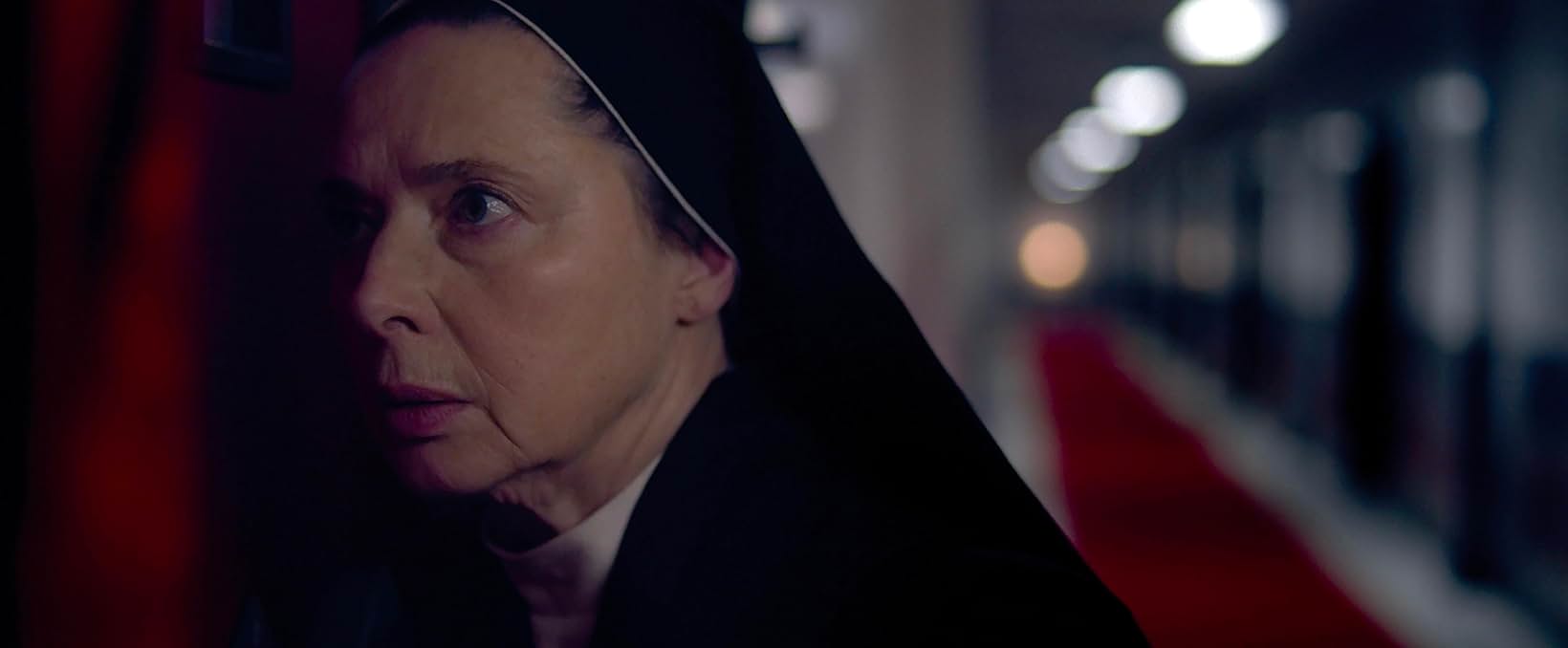
Beyond Fiennes, we also must take note of Stanley Tucci, John Lithgow, and Isabella Rossellini. Tucci is arguably giving the best performance of the lot as an idealistic Cardinal who doesn’t want to see the Church devolve into the dark ages, but who still has more selfish tendencies than he would even care to admit to himself. He’s not in the movie all that much, but he’s a scene-stealer every second he’s on the screen. Lithgow, on the other hand, plays an aggressively self-centered opportunist. Willing to lie, cheat, and manipulate his way into positions of power, he is very clearly written as a one-to-one for Donald Trump in today’s political climate. But Lithgow plays him with a sense of cunning and quiet vitriol that truly makes the character more sinister than you can almost believe. Rossellini stands tall as the pragmatic voice of reason and of the people. She doesn’t get much screen time or much to do, but you could make a convincing argument that she’s the heart of the film. When she has something to say, she says it with purpose and conviction. To that end, she has a moment that is arguably one of the highlights of the entire film, tying a lot of narrative and thematic threads alike all together, and she absolutely nails it. Tremendous stuff.
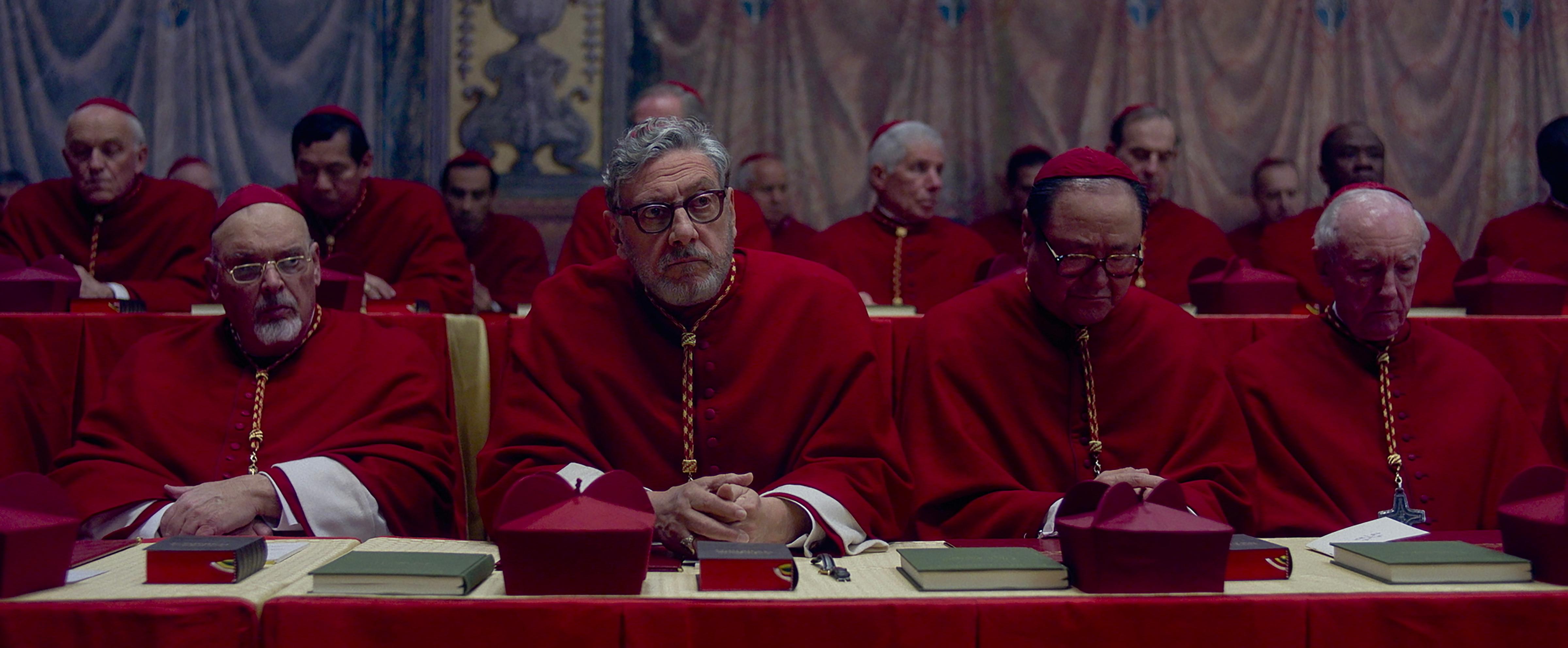
Couple all of these with equally great supporting turns from the likes of Lucian Msamati, Sergio Castellitto, and Carlos Diehz, and you quite clearly have some of the best ensemble work of the year. There’s a scene in a cafeteria, and another in an auditorium, where we truly get to see all of these amazing talents shine brightly as a group. Their chemistry becomes undeniably entrancing as we watch them bounce off one another, matching tone and intensity to deliver captivating work. If the Academy had a category for Best Performance by an Ensemble, this would be a shoo-in for a nomination this year, at the bare minimum, if not a win.
When you stack everything together, it’s hard not to be impressed by this masterful film. You have a relentlessly captivating and entertaining story, propelled by its political machinations and deliberate pacing. You have some beautiful art direction and set design, coupled with some brilliantly moody lighting, to capture the look of the Vatican City, recreating famous locations like the Sistine Chapel. There’s a high anxiety score that makes the hair on the back of your neck stand at attention as you wonder what twists and turns are coming down the pipeline. It’s brilliantly subversive with all of its surface-level values as well as its deeper themes. It’s exquisitely directed, playing like a murder mystery in tone, but without the murder. Reveling in cutting walk-and-talk dialogue segments, delivering an ensemble showcase that will stick with you long after the credits roll, highlighted by a few incendiary performances, and is even quietly one of the biggest pro-feminist films of the year. Conclave has it all.
Yeah, you might have seen a film about controversy in the Catholic Church before. Hell, an argument could be made that some of the choices made by this film might even be blasphemous to some. But if you take this film in earnest and soak up its messaging around the dangers of ambition, the evil in certainty, and the liberation, even in faith, that comes with compassion and understanding, then you’re set to unlock a magnificent film.
Conclave is playing in theaters now.

 Knock on Wood
Leave a comment