
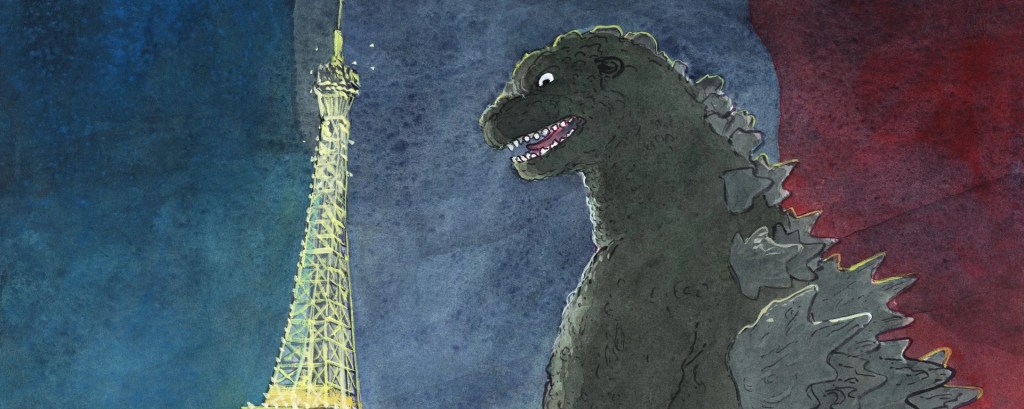
Anyone who knows me will tell you that I’ve always had a particular fascination with The Great Gatsby. Like most American students, I first read it in my high school English class and very quickly became obsessed. My fixation led me to a variety of good-humored Gatsby-related pranks (it’s a long story) and my white whale as a prospective filmmaker, a feature-length adaptation of Gatsby, updated for the modern day and set in a high school. The pandemic interrupted those best-laid plans, but my love of Gatsby hasn’t wavered; in fact, just this year, I’ve seen two musical adaptations of Gatsby’s story; one that perfectly captures the mythic spirit of the American Dream, and one that didn’t.
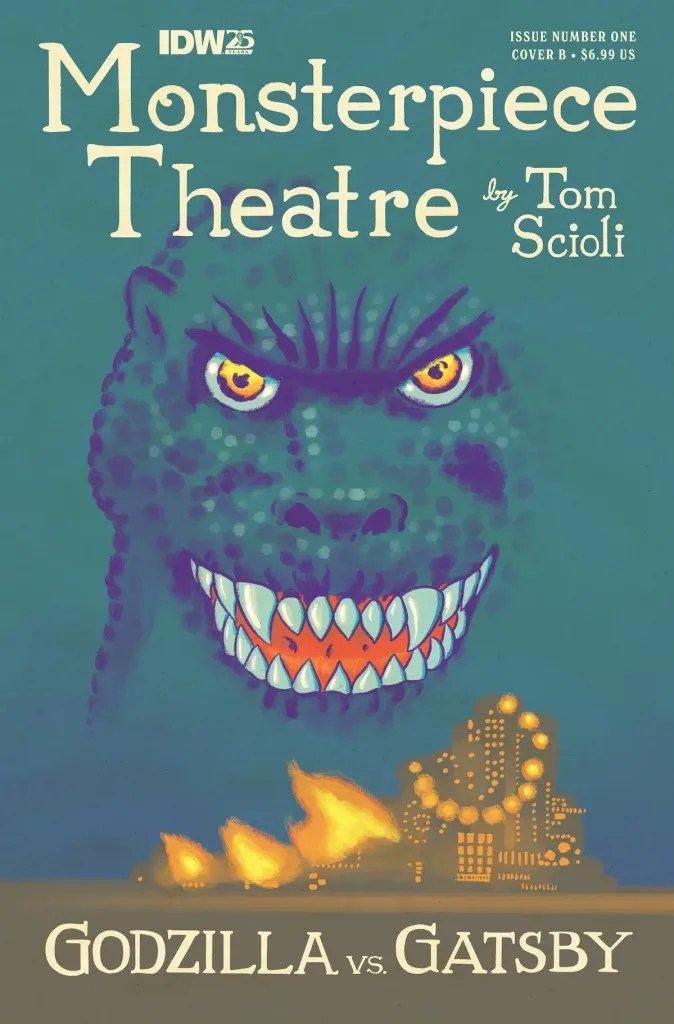
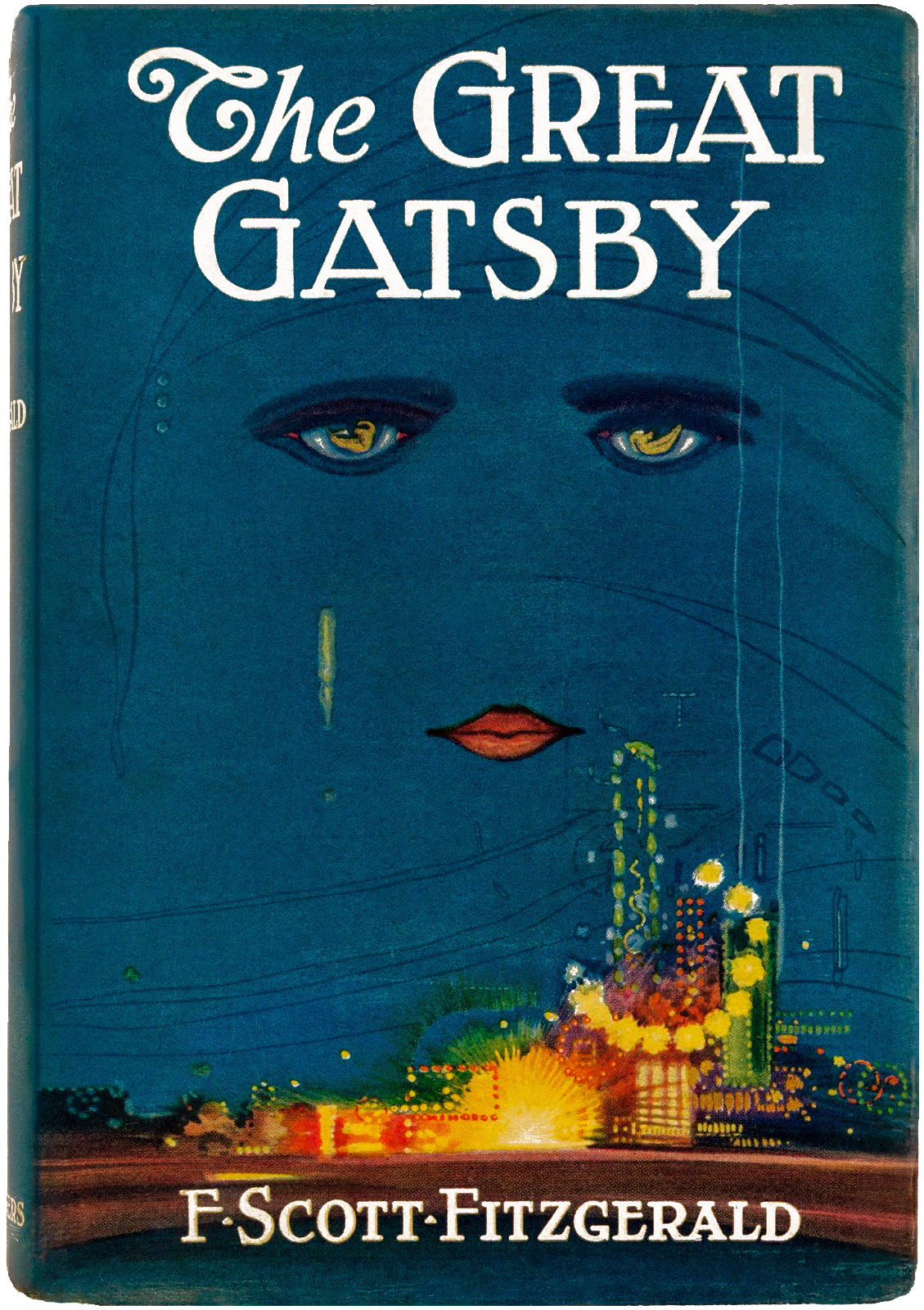
My thoughts of Jay Gatsby and his green light had been dormant since I saw Florence Welch’s musical this past summer, until a routine package from my parents yielded an unexpected accessory: the debut issue of a new IDW miniseries Monsterpiece Theatre, (perhaps a titular homage to the Sesame Street sketches), which featured Godzilla inexplicably interacting with iconic literary characters, all of whom lie comfortably within public domain. On the cover: a gently textured rendering of Godzilla’s face, floating in space above a sketched New York skyline consumed by flames, mimicking one of the most iconic American novel covers of all time. The subtitle: “Godzilla vs. Gatsby.”
I would soon find out that not only was this a variant cover (the original parodies the iconic Fantastic Four #1 cover), but this is one of three eventual issues that will make up this miniseries. With each turn of the 40 pages that make up Issue #1, my eyebrows raised ever higher. Every spread introduced a new audacious idea, so crazy it just might work, so conceptually bonkers that no one in their right mind would ever think of a mash-up like this one.
On the surface, it shares some similarities with Alan Moore’s The League of Extraordinary Gentlemen, which teams up famous literary characters like the Invisible Man, Captain Nemo, and Allan Quatermain to defeat similarly extraordinary threats. Monsterpiece Theatre doesn’t get too ahead of itself, instead choosing to begin with an abbreviated version of a CliffNotes summary of The Great Gatsby: we meet Jay Gatsby in 1917 as he begins a relationship with Daisy Fay before leaving to fight in the First World War. Years later, in 1922, Daisy has married the brash and impulsive (but very wealthy) Tom Buchanan, and Gatsby throws luxurious parties at his Long Island mansion to get Daisy’s attention. We’re not even introduced to the original novel’s iconically unreliable narrator Nick Carraway until eight pages in, after the King of the Monsters suddenly rises out of Long Island Sound, hell-bent on random destruction.
But I’m getting ahead of myself. One of the first things I noticed is how amusingly writer/artist Tom Scioli weaves his own musings into Fitzgerald’s flowery language. Well-known lines like “Reserving judgments is a matter of infinite hope” and “The city seen from the Queensboro Bridge is always the city seen for the first time” are juxtaposed with equally verbose original prose that tends to be more specific to Godzilla’s rampage through the Big Apple. It must have been a writer’s dream to imitate Fitzgerald’s writing style (God knows I had fun translating it into Gen-Z lingo), and the integration of the formality with the innate chaos that Godzilla brings is such a joy.
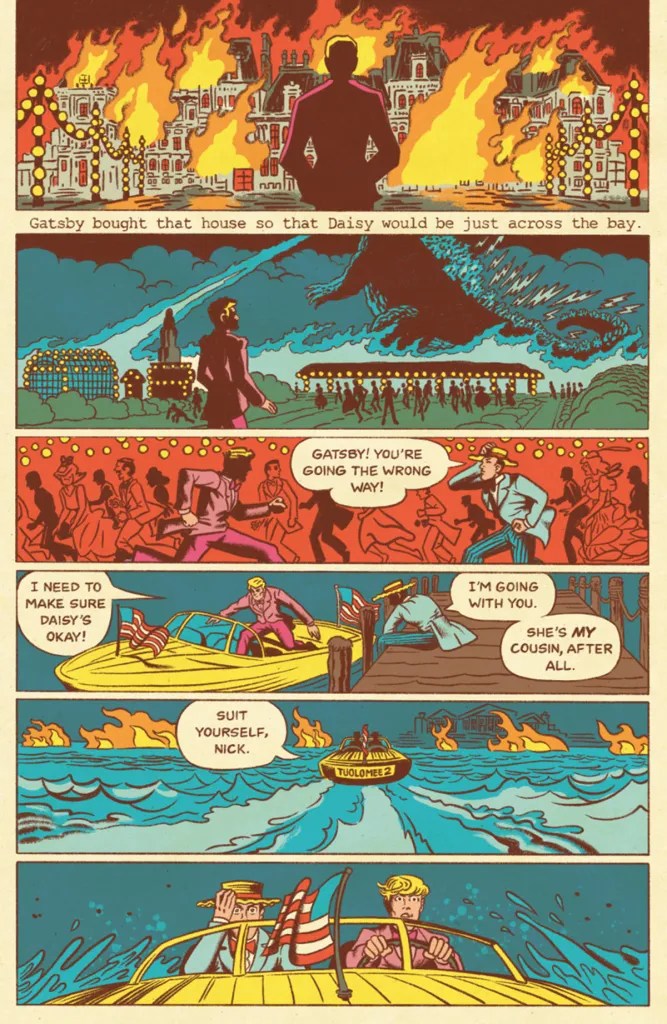
Nick and Gatsby’s dynamic from the novel is essentially cast aside in favor of brand-new iterations exclusive to this story; Tom’s antagonism takes a backseat to the disbelief at Godzilla’s mere existence, and Daisy has even less agency than she has in Fitzgerald’s novel. Monsterpiece Theatre has so much to cover that it seems interested in the idea of these characters rather than how they are written in their original source material, which is perhaps even better – it allows for a new interpretation of these characters, divorced from the baggage of their original appearances, to be transplanted into a fantastical situation that is removed from everything literary about them.
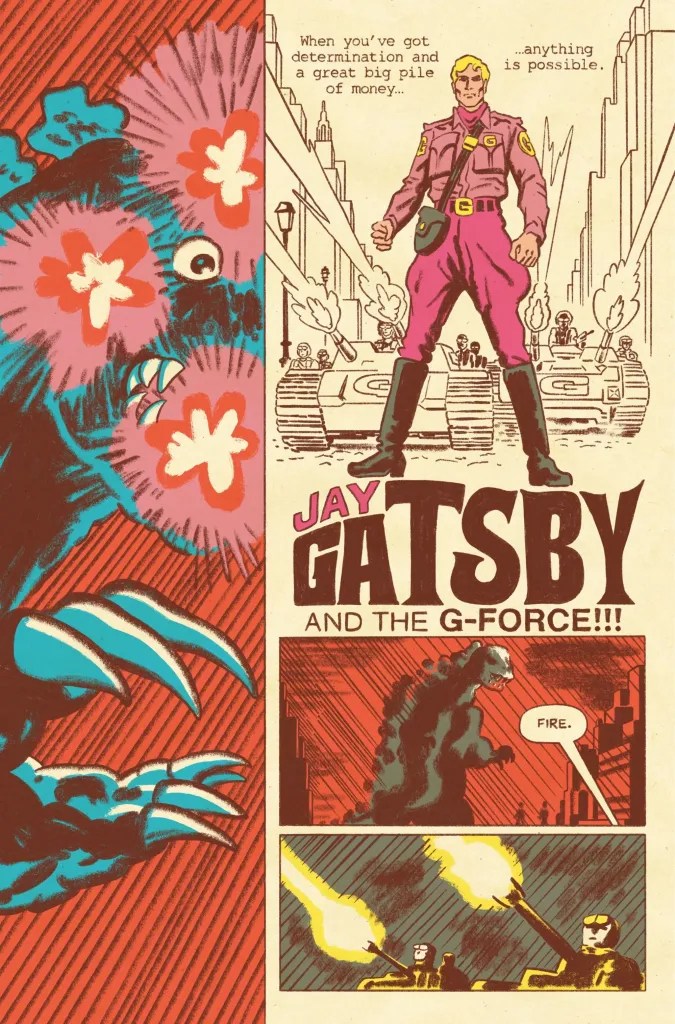
It only gets crazier when Thomas Edison (the first non-Gatsby character, apart from the King himself) accepts Gatsby’s proposal to create a Godzilla-killing contraption, shortly before a citywide attack that leaves New York in shambles. Gatsby forms a government organization called the G-Force to beat it back, but that’s not the end of it – Sherlock Holmes, a cyborg Jules Verne, the Time Traveller (from H. G. Wells’ The Time Machine), and Count Dracula show their faces before the issue wraps with the fallout from Godzilla’s rampage of London.
The first issue fits quite a lot into its limited page count, but Scioli’s artwork makes it a very quick read. There are blocks of paragraphs, sure, but that’s in the spirit of emulating certain Gatsby passages – it enhances the vibe instead of polluting it. The characters are archetypal, distinct in image and color palette but basic enough to help the real star pop: Godzilla, King of the Monsters, practically jumps off the page. He’s textured incredibly well, and you can tell the minds behind this twisted literary crossover have nothing but love for Tomoyuki Tanaka’s iconic creation. No matter what he’s put up against, whether it’s a steamship, mansion, or skyscraper, this is proof that Godzilla’s look is monstrously immortal, and his scale exerts intimidation.
Monsterpiece Theatre is not just an unexpected crossover, but a delightfully silly read. In true comic fashion, it practically dares the nerds to engage in circuitous discourse about what “would” happen if these characters were ever pushed together, and what “logistically” could be feasible in those situations, but that’s what’s fun about it – nothing makes sense. Sure, Jules Verne survived into the 1920s, and he’s a cyborg now! Suspending your disbelief has never been more fun than it is while you’re reading a comic book.
Tom Scioli said it best in a recent promotional interview: “Godzilla is speaking to the reptile brain, the oldest layer of the brain, that’s buried way deep down. Everything else is built on top of that. Godzilla speaks to an ancient elemental part of our psyche. Our dark side. For that reason it’s always going to have an allure.” What could be better for our collective psyches than combining that reptile brain with the most classic literature we’re taught to respect and revere?
Monsterpiece Theatre Issue #1 is available wherever comics are sold. The final two issues will be released on December 18 and January 25.

 Knock on Wood
Leave a comment