
One of the most ambitious risks in the age of streaming-sponsored filmmaking came in the summer of 2021, when Netflix debuted the entirety of the Fear Street trilogy over three weeks. It paid off – all three films (based on the young adult novel series by R. L. Stine) were well-received, critically acclaimed, and among my favorite horror movies of that year. A post-credits scene ensured that a continuation was not only possible, but inevitable, and four years later, we’re back to the dour gloom of Shadyside for another bloody mystery.
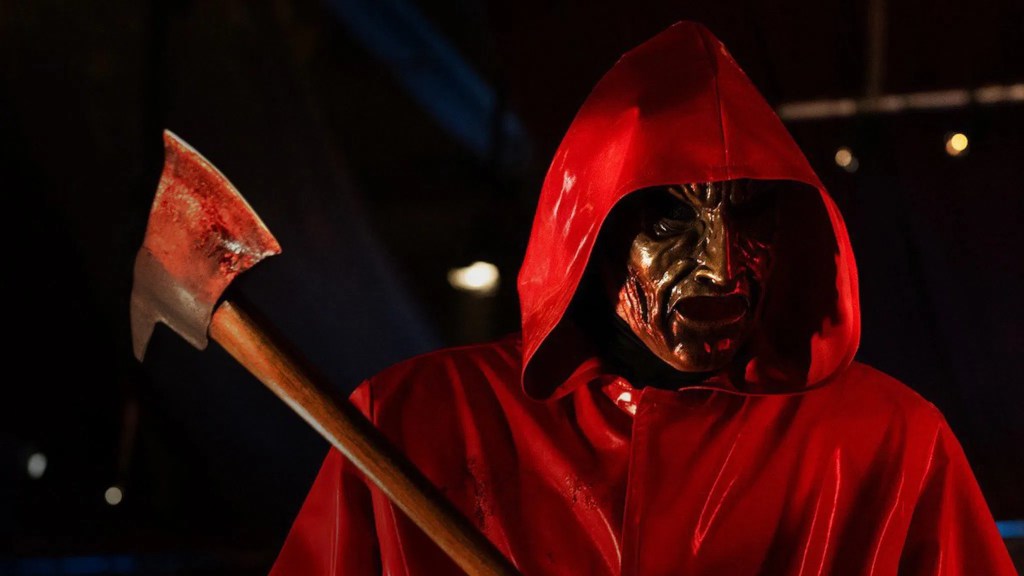
Instead of following in the lineage of the overarching narrative presented by the trilogy, Fear Street: Prom Queen turns back the clock to 1988 (sandwiching it between the 1978 and 1994 installments of the trilogy) and tells a more contained story, in which the title of prom queen is the undeniable zenith of high school social status, and nothing is more important than the crown – thus, the pool of contenders boils down to a group of incredibly distinct personalities, all of whom are vying perhaps a little too intensely for the honor. When the candidates start being picked off by a masked murderer, the abstract horror of high school becomes a gruesome reality, and the fight to survive becomes very literal.

I’m all in favor of an anthological approach to the Fear Street saga (so far, the series has certainly been more successful than recent attempts at a Goosebumps franchise), but my biggest issue with Prom Queen is that it has no reason to exist in the Fear Street universe. There are occasional references to the bloody past of Shadyside – the town in which the series is set – and past massacres depicted in the trilogy, but I spent most of the film waiting for the other shoe to drop, and I left largely disappointed.
Perhaps this is a result of the brainwashing done by an inundation of the franchised, serialized filmmaking that has dominated blockbuster releases of the past 20 years, but I believe that if a film is set in a universe that has been carefully built to accommodate a very specific set of lore, there should be a larger reason for the existence of further stories within it. I’m not saying characters from the trilogy should have appeared, but the way that Prom Queen stands, there is nothing dictating that it can only exist in the Fear Street universe. In a novel series like the Stine one that serves as a basis for the franchise, it’s easier to jump from one story to the next, but for a film franchise that began with a highly interconnected trilogy that both introduced us to this violent world and gave us a satisfying conclusion, it feels jarring to delve back into the pre-established timeline and offer us another story that feels like it could be a part of any other story. Maybe it’s a byproduct of the fact that these are technically TV movies, even though their deceptively high production value might suggest otherwise, but I found myself disappointed with how Prom Queen handled being a part of a franchise I enjoy very much.
That all being said, Fear Street: Prom Queen being your run-of-the-mill teen slasher is not at all a bad thing. As previously mentioned, it has a Netflix budget on its side, which elevates the Scooby-Doo structure with a faux ’80s aesthetic and especially nasty kills that rival some standouts from the trilogy. It harkens very nicely back to iconic late 20th-century stories, where everybody in high school is scathingly cruel for absolutely no reason whatsoever, and correctly plays on the cruciality of social dynamics as the center of its coming-of-age narrative. In a way (perhaps even intentionally), Prom Queen emulates the trashy, exploitative genre hallmarks of the 1980s, slotting in very well with peers like House of the Devil, The Final Girls, and even (nay, especially) the preceding Fear Street trilogy.

Come to Prom Queen for a much-needed return to Fear Street, stay for the gory delights of the modern horror genre – reverent, but assertive, forging its own path while generously indebted to its predecessors.
Fear Street: Prom Queen arrives on Netflix tomorrow, May 23.

 Knock on Wood
Leave a comment