

Guillermo del Toro has always loved his monsters, and his Gothic rendition of Frankenstein (a project he had publicly spoken about for nearly two decades) feels like the apex of his sympathetic obsession. He has long been my favorite filmmaker, and despite how one might feel about his continuing partnership with Netflix, this confluence of his many interests was always going to be fascinating. Whether or not that fascination connects with its audience is something else entirely.
del Toro’s adaptation is a more faithful interpretation of Mary Shelley’s novel than some of the most iconic iterations of Frankenstein’s tale, and his reverence for the source material is evident. A silver lining of his Netflix patronage is that his creativity seems to remain uninhibited – this is the story he wants to tell, and no expense was spared in transporting the images from his head onto the splendor of the big screen.
That’s where the majesty of del Toro’s vision is best experienced – the cinema. Despite a broader theatrical rollout than most Netflix releases (most likely to appease the filmmaker, and to keep him close), the vast majority of viewers will see this for the first time on their home televisions. I can’t speak to how it will play in the comfort of your own home, but what I can say for absolute certainty is that, if you give yourself over, free of distraction, this movie will take you away.
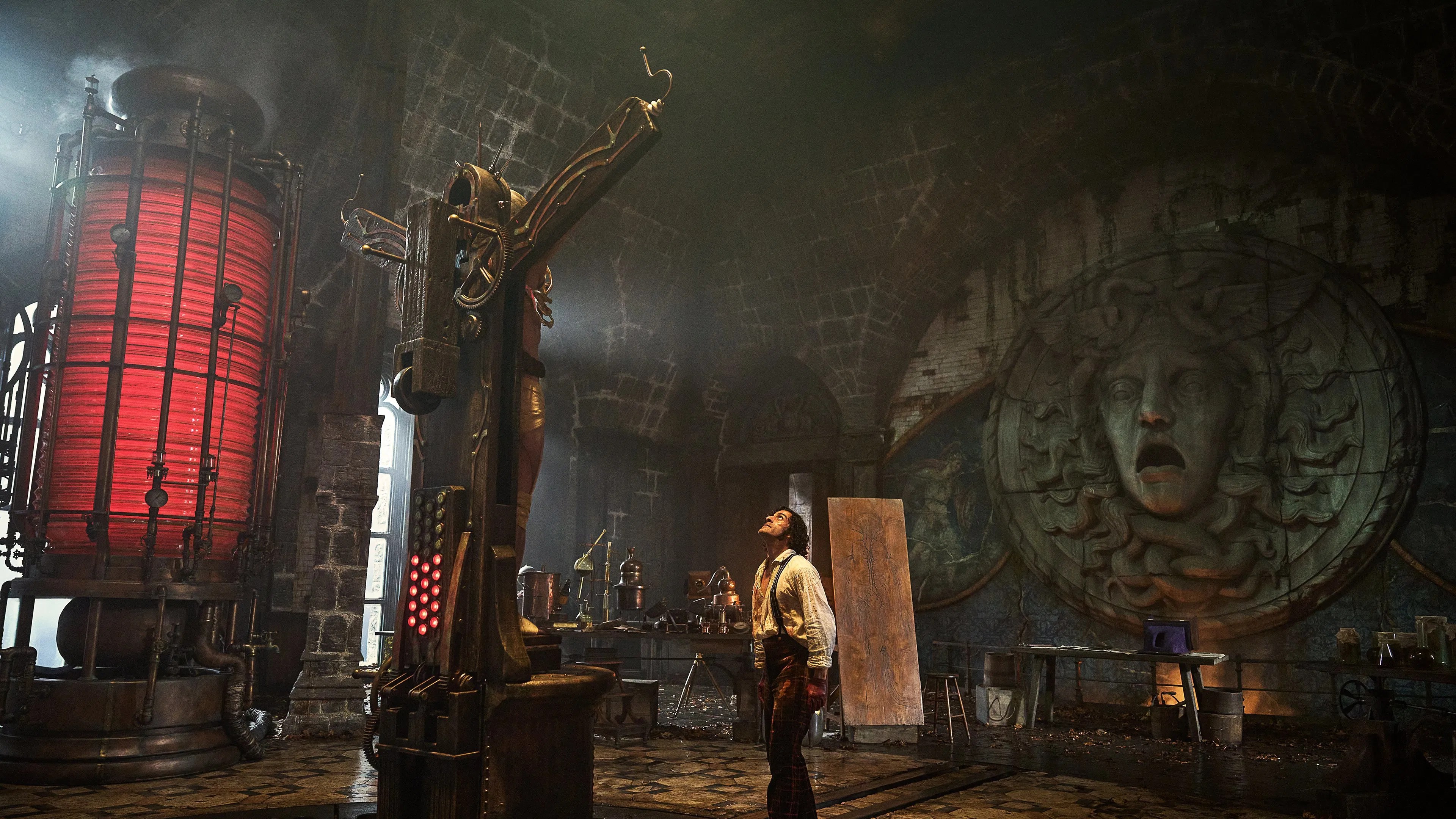
Frankenstein begins in the Arctic, as a North Pole-bound expedition discovers the injured scientist Victor Frankenstein (Dune’s Oscar Isaac) abandoned on the ice. Soon, they come face-to-face with Frankenstein’s Creature (Euphoria’s Jacob Elordi), and both the mad doctor and his creation recounts their tales of woe and hardship.
Perhaps it’s my (sometimes blind) devotion to the absolute mastery of Guillermo del Toro, but Frankenstein thrilled me for two and a half hours. It takes its time in guiding Victor towards his ultimate goal – plenty of time is spent on his experiments with body parts from Crimean War soldiers, including his allyship with a wealthy arms manufacturer (Django Unchained’s Christoph Waltz) and his strained relationship with his brother’s fiancée (Pearl’s Mia Goth) – but it’s all in service of the crucial development that leads him to become the disgraced maker of a maker. It takes quite a bit of time to get to that creation, but I was captivated from minute one.

There’s a part of this film that seems aware of its own pressure – perhaps not hesitation or nerves on del Toro’s part, but a weight to this tale that has only amassed more power since his initial enchantment with the story of Victor and his Creature. It’s also an innate warning (and, to be fair, this one is present in the source text as well) against giving in to grandiosity and greed when seeking glory and meddling with ideas beyond your control. The first half of Frankenstein reckons deeply with that uncertainty, but just as Victor Frankenstein proceeds with his ambitious quest to conquer death, so does the maestro behind the camera dive into his lifelong passion project head-on.
The arrival of the Creature is the turning point, both for Victor and the film itself. With a new life in his hands, Victor becomes his father, a paragon of cruelty in the name of education. Now, with two perspectives instead of one, del Toro’s Frankenstein widens its scope by necessity, becoming a well-rounded examination of good and evil instead of limiting itself to one man’s search for recognition and achievement. It’s only fitting – while Isaac, Waltz, and Goth are good, Jacob Elordi is the key to the film. I will admit to holding the most doubt for him, and I was surprised to find his performance the best in the film. He channels his pretty boy screen presence into a Creature full of pathos and deep, raw feeling. His portions of the film are the most dynamic, the most engaging, and by far the saddest. The makeup is incredible, too – he’s recognizable, but still singularly defined as a unique figure.

I, for one, am incredibly glad that Guillermo del Toro finally got to make his Frankenstein. If there’s anyone who can frame a tale about the true nature of monsters and the utter agony of being alive, it’s him. His take on the Modern Prometheus is beautiful, and nearly brought me to tears in its final scene. Like the rest of his work, it’s undeniably cinematic, a true transportation to a world so far removed from our own, it’s like living in a fantasy. Frankenstein doesn’t need to be del Toro’s magnum opus – it’s a fully-realized work of art with the full weight of a soul in its hands. Just like Victor’s dreadfully misunderstood Creature, Frankenstein could not have been made by anyone else.
Frankenstein is playing now in select theaters and will debut on Netflix on November 7.

 Knock on Wood
Leave a comment