

Welcome to class! My full-time job is working at a university, and I teach as well. One of my dreams has always been to teach a film class. Taking students through the world of cinema and helping them learn about the art form that I am so passionate about would be an amazing experience. But alas…I teach math. This series, “Lessons from the Wasteland,” is my opportunity to offer readers a curated watchlist to learn through doing (…watching movies). Each film on this list will highlight either a filmmaker, sub-genre, filmmaking technique, or significant topic in order to broaden your cinematic horizons. For this month we have…
Stanley Kubrick
Dr. Strangelove or: How I Learned to Stop Worrying and Love the Bomb (1964)

War…what is it good for? Kubrick was a director who certainly had a lot to say about the subject. He tackled it through one of his earliest efforts (Fear and Desire) before he dove into World War I with Paths of Glory. His efforts to reflect the evils and needlessness of wars, especially with World War I, have been greatly appreciated over time. He did the same with Vietnam with Full Metal Jacket. But his most unique perspective on war and global conflict just so happens to be his funniest film as well.
Dr. Strangelove is a pitch-black satire that looks at one of the most complex conflicts of the 20th century. The Cold War was full of paranoia that drove both the United States and the Soviet Union to the brink of all-out war, and Kubrick focuses on a few distinct moments that would finally push this heated conflict over the edge into a nuclear holocaust. Seems like a dark subject matter for a comedy. But no one will argue that Kubrick was your average, run-of-the-mill filmmaker. Dr. Strangelove perfectly balances its commentary on the superfluous tensions and the global danger these two juggernauts put the rest of the world in. The absurdity of this madness is where Kubrick finds the humor. You have a bomber given orders to bomb the Soviet Union but cannot receive the cancellation orders. We see a cowboy (of course) who literally rides a bomb like a bull at the rodeo. Slim Pickens played it perfectly. We have a paranoid and dangerous military man who has his thumb on the doomsday button…just look for an excuse. How could we have someone of such ill repute in a role like that? Someone like that would obviously want to find themselves in that situation. Sterling Hayden’s Ripper is unhinged enough to make it all happen. Then we have to War Room…but we cannot fight in it, right? George C. Scott is the manic war monger that you would never want to run your military…but probably would be the one to reach that position.
The true feat of Dr. Strangelove is that Peter Sellers delivered a trio of performances for the ages. His President Muffley is such a weak and docile man in the face of a horrific future. His prim and proper Captain Mandrake keeps it classy (to a fault) in the sight of the horrors of war. But Dr. Strangelove is an unhinged Nazi scientist who, of course, would be the top science advisor to the President. Kubrick knew the truth: the world is so absurd and deranged…you just have to laugh.
2001: A Space Odyssey (1968)
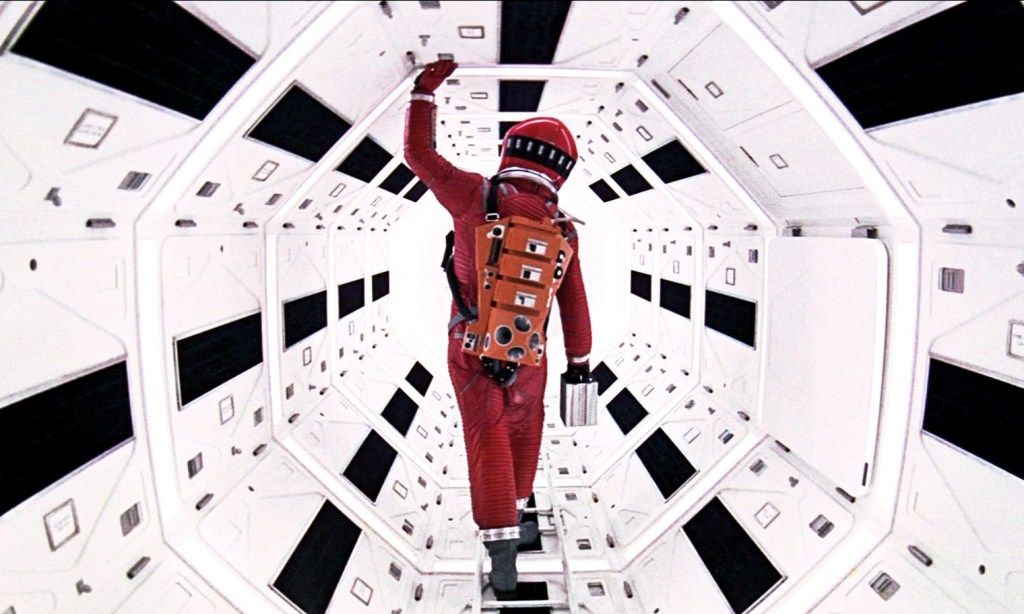
What is the most defining film in the history of science fiction? That seems to be a bold statement for one singular film that could possibly define an entire genre. But…this is Kubrick, and he did create 2001: A Space Odyssey, an incredible feat of science fiction, that in no small part originated from the contributions of novelist and inventor Arthur C. Clarke. This legendary futurist was able to see into the future and bring to life such elements as tablets and radar.
The technical prowess of 2001 is nothing short of miraculous. The advancements that Kubrick and Clarke bring to this from a filmmaking perspective are impressive. The way Kubrick makes spaceships dance through space is elegant and moving. The creation of zero-gravity as well as the running around a circular space are awe-inspiring to look at. The most impressive achievement is the practical effects that create the internal workings of a wormhole. The visualizations of this part of the film are incredible and eerily engrossing. Kubrick shows off his flair for visual storytelling throughout 2001 but in the “Beyond the Infinite” section, we are provided a haunting visual experience that is quite hard to describe but certainly delivers an empathic conclusion to this cinematic expression of evolution.
Kubrick injected so many themes and ideas into 2001. The foundation is the universal idea of human advancement. The good. The bad. The unknowable. The leaps from ape to pseudo-human to space travel to artificial intelligence to the Star Child (a being beyond human comprehension) are told poetically through the expression of film. The symbolism is clear when it comes to reproduction, birth, and the furthering of our species. The sperm-shaped ship. The black gaping void of the Monolith. The “born” child at the end of the film.
Kubrick certainly cemented himself as one of the greatest filmmakers of all time with this iconic film. The usage of classic music has permeated the vast expanse of cinematic culture. There are cinematic elements that live on forever. The ape who throws his bone to the skies (one of the best edits of all time, as it transforms into a spacecraft through a match cut). The red eye of HAL-9000, who is arguably the greatest antagonist in the history of film (with Douglas Rain delivering a haunting voice performance). The Monolith kissing the prehistoric sky as well. This is one of the most beautiful films ever created.
Barry Lyndon (1975)

Many filmgoers are either in the “love” or “hate” category in terms of their attachment to period dramas. Many love the period details and the call back to bygone eras. Others find them stuffy and old-fashioned. You can certainly make your arguments. But one thing is for certain…few period dramas feel like Kubrick’s Barry Lyndon.
Certain trappings feel emblematic of the genre for sure. There is pervasive narration throughout, which gives it an old-school cinema feel. You at times feel like you are being read a demented and screwed-up fairy tale story…in a strange way. The visuals and design details are off the charts. It’s Kubrick…why wouldn’t they be? There are many wide-frame shots of the land and world around Redmond Barry (our protagonist portrayed by Ryan O’Neal) that are based on famous paintings. The cinematography and production design are also quite exquisite. This is one of the most beautiful films you will probably ever see (and that is saying something when it comes to Kubrick). There are sequences in the film where Kubrick and cinematographer John Alcott set up a seduction sequence over a game of cards that is shot completely in natural light. The richness of the shots and composition is breathtaking. Few filmmakers can capture the beauty and potential of film as Kubrick did. Like all of his films, there are endless shots from the film that are striking and art in their own right. The costuming and makeup are awe-inspiring as well, with so many vibrant and eye-catching moments.
But not everything is so beautiful in Barry Lyndon. That is where Kubrick finds the subversion. There is a darkness and vileness to our young Redmond Barry. He is an arrogant, passionate, reckless, and frustrating individual whose choices breed his downfall in the end. He is a child in a man’s body who navigates a sprawling world like a naive boy listlessly wandering his existence. There is violence around every turn. Brutal and awkward, unlike the honorable and refined manner we expect from a period drama. The sex is less passionate and fiery but more dirty and uncomfortable. This is a deconstruction of the period drama mythos that cinema had created.
Kubrick always loved to adapt other works. But the important message to remember is that he loved to play in other people’s sandboxes (whether adapted works or genres)…but never by their rules.
The Shining (1980)
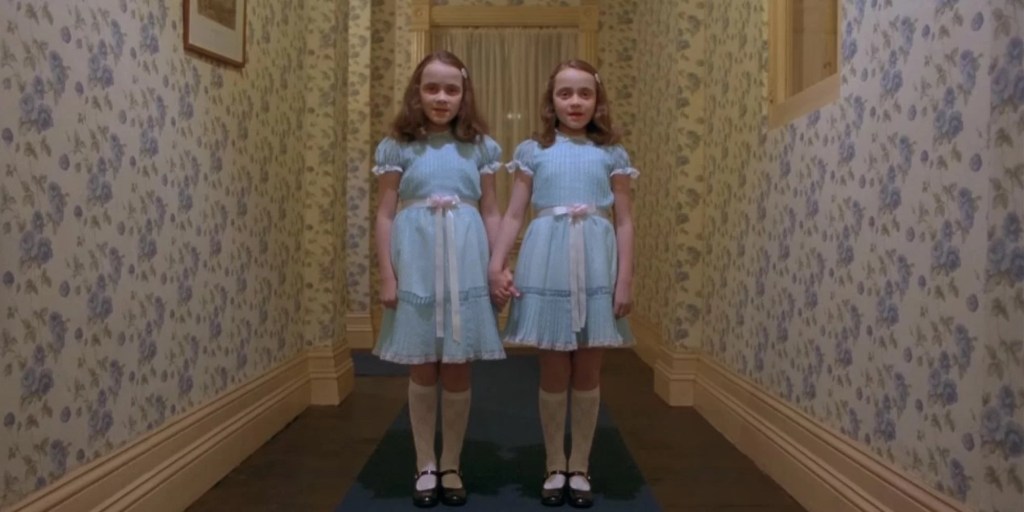
The Shining is the key example of Kubrick’s control and drive to do it “his way.” Many people today relate this horrifying tale to Kubrick’s film. But The Shining was not born of Kubrick’s creativity. He certainly had no qualms about bastardizing and morphing it. The story was actually a creation of Stephen King. The book that King wrote was a harrowing ghost story that shows the horrors of alcoholism and abuse. Jack Torrence was a tragic character who needed to finally overcome his vices to save his family in his final moments. If you have only seen the film, that must sound incredibly foreign to you. That is not the Jack of the film and that is certainly not the approach that Kubrick took.
There was a framework. A hotel. Horrific spirits inhabit it. A man isolated from his family. What could go wrong? Those are the broadest strokes of The Shining, but Kubrick took charge and used them to create one of the most unnerving horror films of all time.
There is not a strong sense of empathy for Jack Nicholson’s portrayal of Jack Torrance. From the start…you can tell something is off. The Overlook Hotel has its way with him as he descends into madness and violence. Nicholson was the perfect casting for the Jack of Kubrick’s tale. There is a madness and danger in every stare and line delivery that Nicholson has. His manic persona creates a horrifying presence that will certainly put anyone on edge. But Kubrick was able to create one of the most haunting and visually arresting horror films of all time because…well, he is Kubrick. The visuals are perfectly framed and symmetrical. The steady camera follows Danny around as he rolls his tricycle around this eerie and impossibly-designed hotel. The colors are a mix of classic hotel style of excess and 60s/70s aesthetic. The one sequence in the men’s room with the striking red colors is penetrating.
The most unnerving element of the film is the soundscape. The music is other-worldly, to say the least. There are aggressive horns and percussion instruments. The rattles are bone-chilling; they create a sense of terror and mania. The ghostly figures of this creep hotel are quite iconic themselves, from an agreeable bartender to the quietly menacing Grady, to the man in the dog costume. Few horror films quite feel like The Shining and that is certainly true, thanks to Kubrick. This is an unnerving experience but one that will sit with you…forever.
Eyes Wide Shut (1999)
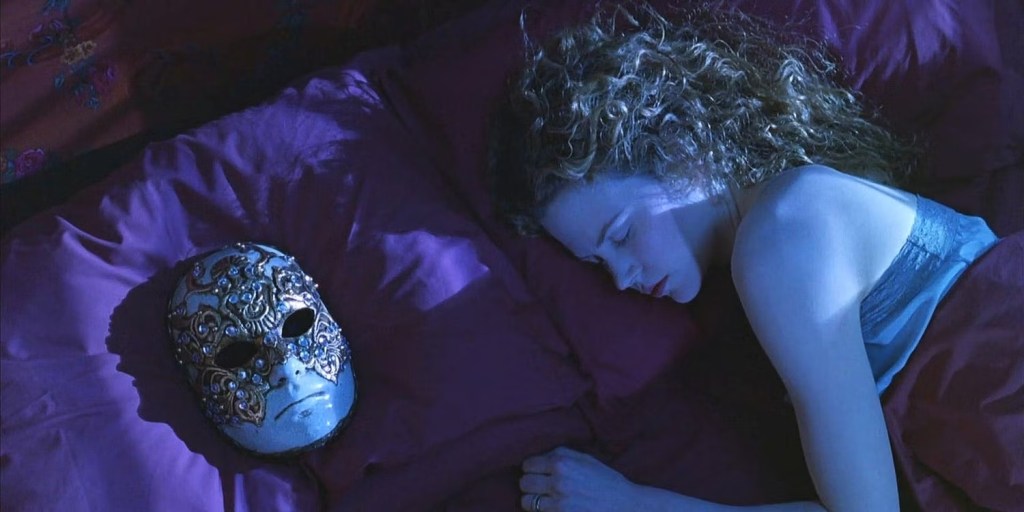
What was the final cinematic offering Kubrick had for the world before his untimely death? Something dark. Something sexy. Something uncomfortable about control of one’s life. That is Eyes Wide Shut. Similar to all of Kubrick’s films, this stands alone in the realm of erotic thrillers. This is not your by-the-numbers film that checks all the boxes. This one steals your list and tears it up right in front of you then takes you on a wild erotic ride in the life of a young, handsome, and seductive man portrayed by Tom Cruise. When his wife (Nicole Kidman) reveals a steamy fantasy she has kept buried for a long time, Cruise’s Bill goes on an evening-long sexual exploration filled with sex workers, seductive teens, and masked rich people’s orgies. This is an experience that I am sure most average people would never be seeking out. But deep down…would we fantasize about it? That is the deeply primal element of humanity that Kubrick exposes in this cold and unnerving erotic thriller.
There is never a sense of warmth in Kubrick’s work which makes for an interesting juxtaposition when it comes to this lusty and erotic film. There are plenty of moments that are full of nudity, kissing, and seduction. Those same scenes avoid passion. There are dangers, jealousy, trauma, desperation, and plenty of other emotions and feelings that stream through this twisted evening for Bill.
Kubrick was a filmmaker who dug deep into the darkest depths of the human experience. This is not a love story. This is a journey of one man processing through the taboos and pitfalls of sexual experiences. Cruise is an actor who most would see as the charming young doctor easily but this film drives this character to dark places that most would not expect a big movie star like Cruise to navigate. Through each of these films, we have shown why Kubrick’s films stand out so much amongst other filmmakers.
There might be a blueprint for the genres that Kubrick explored, but he always threw them out the window and instead chose to clash with the expectations. This is not a hot and steamy thriller that will get you enthralled in that way. It is instead a cold and distant dissection of the darkest elements of us and what makes us feel. What a way to go out for Kubrick, right?
Also see: Full Metal Jacket, A Clockwork Orange, Spartacus, Paths of Glory

 Knock on Wood
Leave a comment