

Yesterday, I sat ten feet away from an artist who has risked everything for their art. As an artist myself who was raised in the relative safety of a small, coastal American town, it was a sobering experience to hear him speak about everything he has endured in his lifelong mission to create art that transcends borders and exemplifies honesty and truth. Everything I’ve dealt with in my life seemed like small potatoes next to this brave and brutal fight against censorship.
That artist was Mohammad Rasoulof, an Iranian writer and director who has, time and time again, released films that criticize his country’s totalitarian government both directly and indirectly. Because of that, he has been a political prisoner on and off for almost 15 years.
His latest film might have changed his life permanently. The Seed of the Sacred Fig was filmed in secret in Iran last year and, upon the film’s acceptance at this year’s Cannes Film Festival, the entire cast and crew was interrogated and banned from leaving Iran. Rasoulof fled the country along with whatever cast and crew he could take with him, and he’s since been unable to return. Stacked prison sentences and numerous (likely vicious) punishments awaited him if ever chose to go home.
The Seed of the Sacred Fig now stands as the unyielding statement on his home country. It incorporates Rasoulof’s experiences with interrogation and Iran’s infamous Revolutionary Court to create something strict and solemn. It emblematizes Rasoulof’s unfailing strength to stand up for what he believes in, and for that I believe it’s not only one of the most important films of the year, but also of the decade.
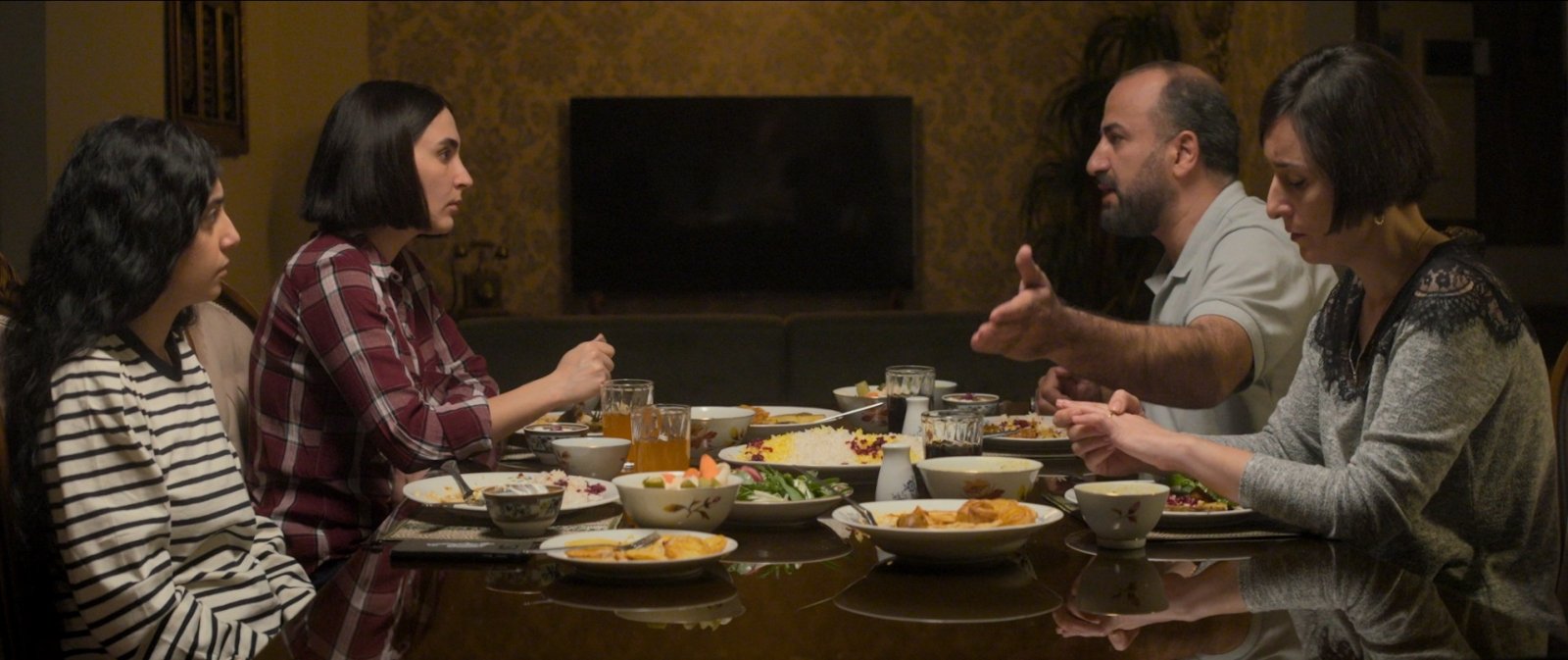
Very rarely does a film feel raw and significant in the way The Seed of the Sacred Fig does. It doesn’t exist because the director willed it into being, it exists because it demands to. There is no world in which it doesn’t. Rasoulof put everything he had into it, not just because he wanted it to, but because it’s his duty to share this story. Even if their stories haven’t reached our shores, it symbolizes the feelings held by many Iranians, trapped in a country that refuses to move forward while the world around it changes faster and faster each day.
A fractured family lies at the center of The Seed of the Sacred Fig. Father Iman (Missagh Zareh) works as an investigative judge for the Revolutionary Court, a secretive position that puts himself and his family at risk. His wife Najmeh (Soheila Golestani) struggles to maintain a balance at home with their two daughters, the strong-willed Rezvan (Mahsa Rostami) and quietly defiant Sana (Setareh Maleki), both of whom sympathize with the Women, Life, Freedom movement. Their already turbulent lives are turned on their heads when the gun Iman was given for protection goes missing, and all hell breaks loose.
My theater was dead silent for the entirety of the film…and in the age of cell phones, an entire theater shutting up and paying rapt attention to the movie they paid to see for 2 hours and 47 minutes is (unfortunately) a miracle. Even if you don’t take into account his eye for blocking and ability to evoke effortlessly incredible performances, Rasoulof has another, more subtle talent, and that is ensuring you are always aware that what is happening, even if the specific situation is filmed as a fictional narrative, is real. More than once, Rasoulof cuts to (often grainy) footage of bloody protests and small rebellions happening on the streets of Tehran, Iran’s capital, and it always succeeds in sharpening the film’s perspective. It reinforces that this is a movie that demands to be seen and processed, as you would any contemporary justice-focused work of art. It’s not a film so much as it is a dramatic portrait – this is happening in the world right now. Pay attention!

Rasoulof did not direct The Seed of the Sacred Fig on-set. For the safety of both himself and the cast, he had to be isolated in a separate location, and the fact that he poured his entire being into a story he couldn’t even witness in person is nothing short of admirable. A lot of people have (and will) call this film ‘important,’ but it’s crucial to know why, and to view it in its larger context. The Seed of the Sacred Fig is a totemic work, and one of paramount importance in the world we live in today – it could be the final film from someone who has risked more for their creativity than I could ever fathom. It’s the epitome of art worth fighting for. See it.
The Seed of the Sacred Fig opens in select theaters on November 27.

 Knock on Wood
Leave a comment