
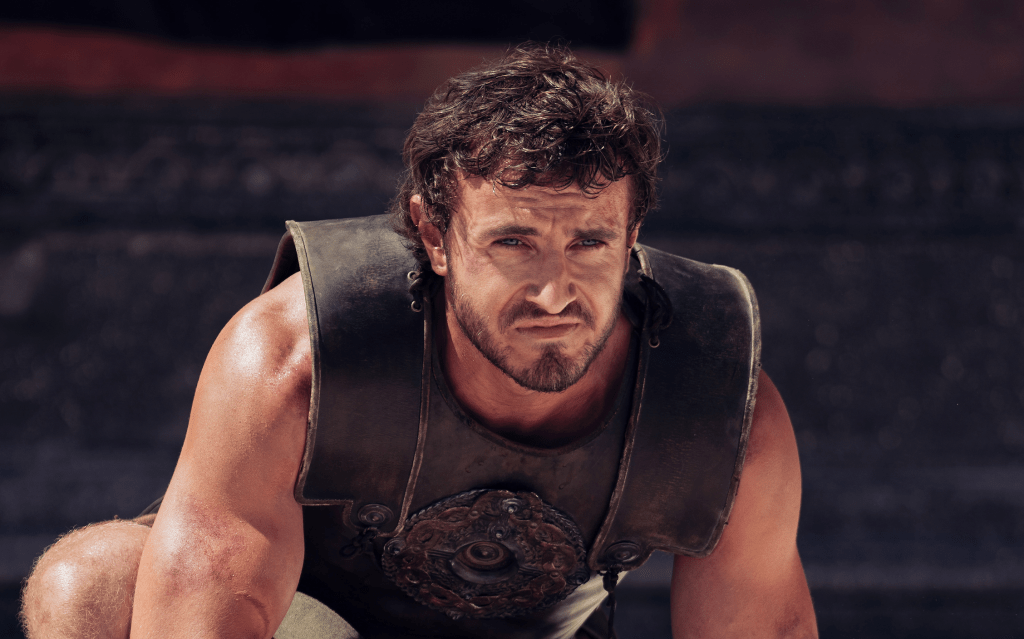
Ridley Scott has directed some of the most iconic movies of all time, from Alien to Blade Runner to Gladiator. Each time, he went back to the well in one form or another. He directed Prometheus and Covenant, two prequels to Alien, which bring a grand and philosophical tilt to the survival franchise; Scott was involved as an executive producer for Denis Villeneuve’s Blade Runner 2049, a movie that takes the ideas from its then-35-year-old predecessor and patiently expands on them. Both of these movies do well to take what came before and expand on them in new and exciting ways.
But it’s a bit of a different story with Gladiator II. For a director who, even when he’s returning to a franchise, has historically brought something new or interesting to the table, it’s a surprise that his Gladiator sequel feels so distinctly in line with the glut of legacy sequels Hollywood’s been enjoying churning out in the last decade. Flashbacks to the original, matching visual ideas, lines of dialogue, and items of significance abound, and they dull the overall experience, at times making it feel like the same old nostalgia play we’ve grown accustomed to.
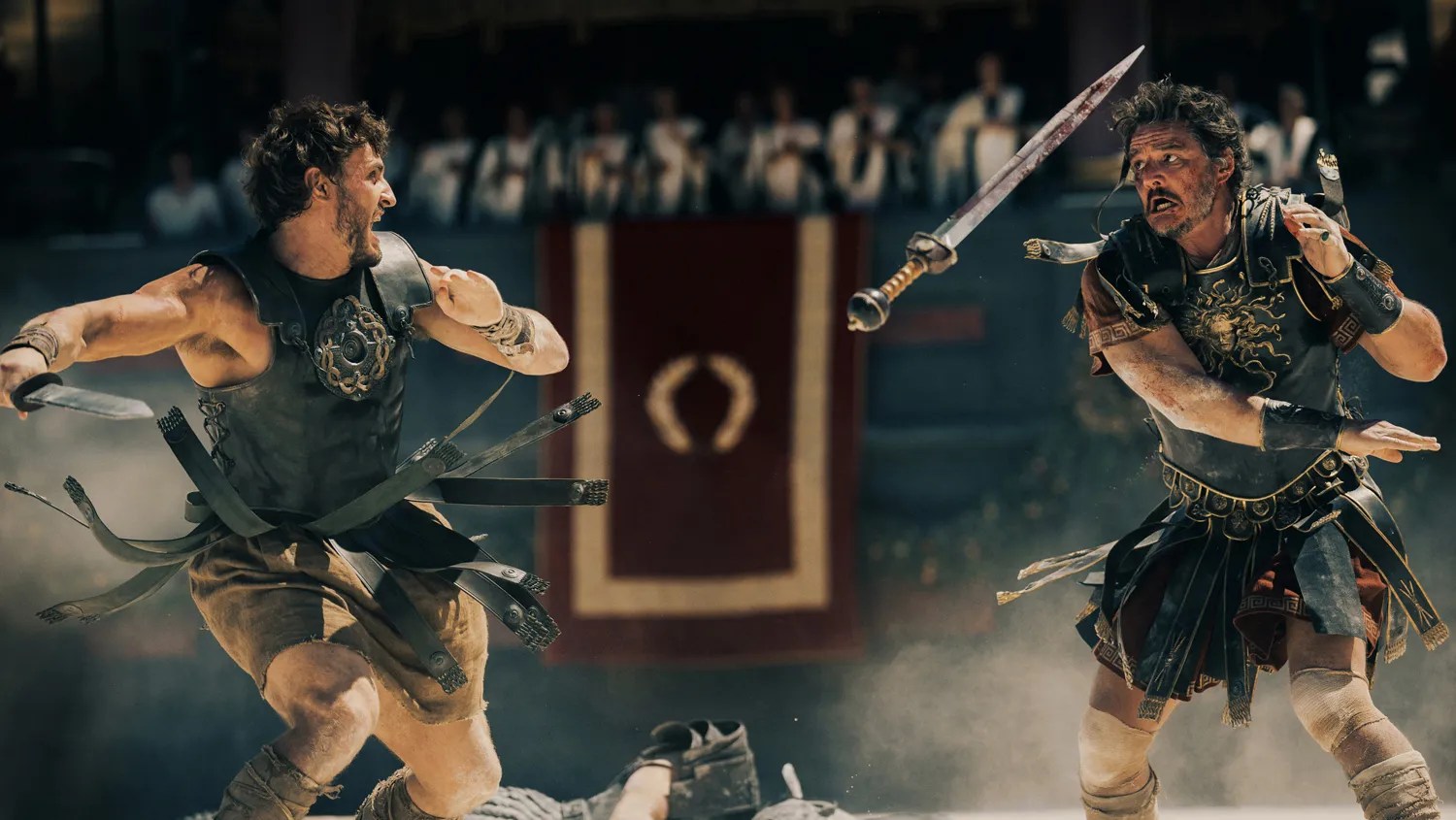
This is extra disappointing because of how promising the film’s setup is. Hanno (Paul Mescal) lives in Numidia, where he fights as a soldier (the opening sequence is immediately reminiscent of the original: a large-scale battle sequence whose bearing on the rest of the movie is to start it off with action and set up the protagonist’s central conflict). But when the Romans attack and kill his wife Arishat (Yuval Gonen) under the command of General Marcus Acacius (Pedro Pascal), Hanno is taken captive to fight as a gladiator. He’s then bought by Macrinus (Denzel Washington), who says he’ll give Hanno Acacius’ head in exchange for his gladiatorial services, since he can’t give him all of Rome. The catch is that Acacius also secretly wants to take down the Roman empire and restore its republic, because the twin emperors (Joseph Quinn and Fred Hechinger) are far worse than Joaquin Phoenix’s Commodus ever was.
All of that is set up within the film’s first 20-ish minutes. There are so many fascinating avenues it could go down with the character dynamics it sets up, but instead, it double dips with reverence, like so many of these other sequels. And despite a specific reveal being shown in the trailers and in the IMDb cast list, it’s still dragged out before we’re finally left to disregard much of the fascinating setup. Before he even gets a chance to make an impression, Pascal’s character is largely pushed to the wayside in favor of his wife, Lucilla (Connie Nielsen), who returns for the sequel. While she’s very good in the movie, she’s more of a conduit to drive a connection to the original film than she is a character who exists in the film’s present.
What makes this all extra frustrating is that Scott’s shown time and again that he can disregard parts of his previous work in favor of telling a new, trailblazing story. People were upset in 2012 at the lack of Xenomorphs in Prometheus, but I give as much of a shit about those in that context as Scott does, and Prometheus is one of his better films because it commits to its ideas and executes them. Gladiator II is committed to its ideas insofar as it can quickly retrofit them to the original, thereby stripping them of much of what made them so compelling in the first place.
Being so self-referential is just a color that doesn’t look good on Ridley, because it makes the movie’s commentary on Rome and empires in general feel that much more feeble. If the movie had the bravery to stray from, or add on to, the past (like Prometheus or Blade Runner 2049) and stay on those original paths without shoehorning in everything we remember from Gladiator, I’d be having a very different reaction to the movie. Because despite my strong misgivings, there is a lot to like about Gladiator II amidst the mess.
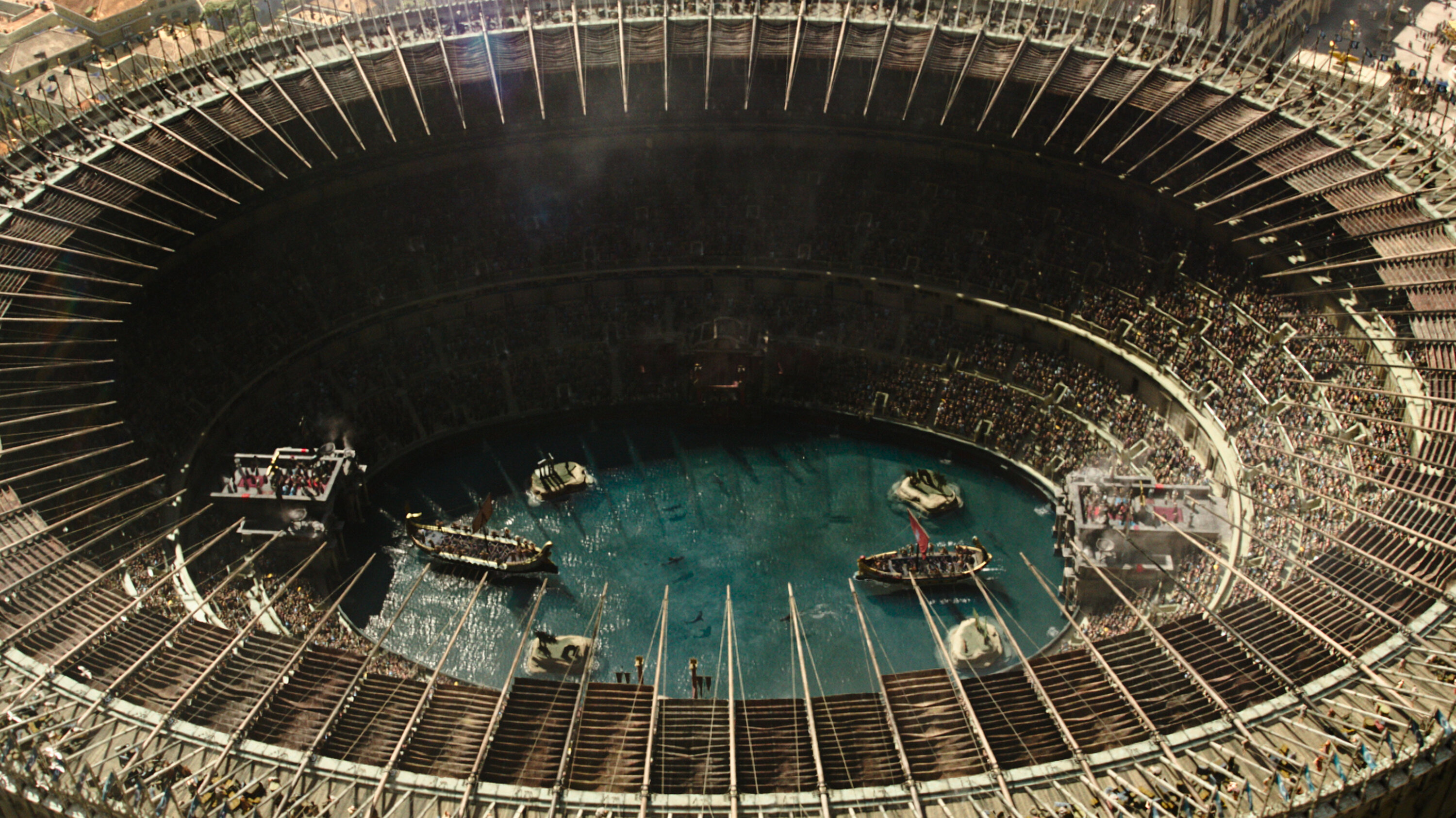
To start, when you put a guy built like Mescal in the Colosseum and have him fight baboons, sharks, rhinos, boats, and guards, and you have Scott direct it, it’s just a rollicking time at the movies. Even though the CGI is questionable at times, it’s still thrilling to watch Mescal wrestle a baboon with his hands chained together. Or the Colosseum filled with water for a boat battle between gladiators. Or a group of gladiators trying to work together to defeat a guy on a rhino charging them, this time with good CGI (and maybe even a moment that’ll have you feeling bad for the rhino).
Just take a look at Mescal in All of Us Strangers and you’ll see that he was just waiting for a physically demanding role like this. For the most part, he pulls it off. The one real character trait that the script allows him to have is rage, and he is strong, silent, and animalistic when he’s given the opportunity to fight. But at the same time, because comparison is the thief of joy, Mescal’s performance serves to demonstrate how much raw charisma and star power Russell Crowe exuded in Gladiator. He has a kind of magnetism and screen presence that Mescal lacks. Even for how honest it is, his performance feels rehearsed. He’s not bad in the movie, but the emotional vulnerability that allows him to own the screen in Aftersun and Strangers doesn’t quite translate to rage.

Antithetically, Washington’s performance surpasses all the rest, and it’s not even close. He shows everyone around him what it means to simultaneously be a movie star and an actor (i.e., he makes choices that feel like they couldn’t have been rehearsed; they’re “how did he think of that?” choices), yet as I watch his character finesse his way through every situation he finds himself in, his ultimate motivation falls flat because it is a reaction to the Rome that’s discussed in the previous movie and not the one that’s in front of him.
That’s where my real issue with the film, and Scott as a director in general (though he’s one of my favorites), comes from. The script was written by David Scarpa, whose most recent film credits are Scott’s Napoleon and All the Money in the World, two mostly unsuccessful movies in terms of their storytelling. And the quality of Scott’s movies is very often dependent on the script he’s working with. His movies are typically visually and tonally excellent, creating memorable images and sequences, but he doesn’t really elevate material. When he has something great to work with — Blade Runner, Kingdom of Heaven (the Director’s Cut), The Martian, The Last Duel — that’s when we get incredible movies worthy of discussion.
Gladiator II falls into the former category. In being so indebted to its predecessor, it doesn’t rise to the upper echelon of Scott’s impressive filmography. But it’s got an ineffable, perhaps pulpy, quality that allowed me to have a great time at the movies. It can be so over-the-top and captivating that the weak ideas and characterization become negligible. I do have a great deal of disappointment that Scott’s penchant for going all-out in terms of his grandiose commentary was sacrificed at the altar of “Remember This?,” but his penchant for going all-out in terms of scale and action was left untouched. And I am a simple man: When Ridley Scott is given free rein to make a movie with swords a bit bonkers, I am happy.
Gladiator II opens in theaters on November 22.

 Knock on Wood
Leave a comment