
You know it’s an interesting year for movies when there’s a Coppola on the marquee. This year has a double bill – not only did Francis Ford Coppola, the legend himself who began the dynasty, finally release his long-sought passion project, but his granddaughter Gia Coppola has released her highest-profile film yet: a relatively small indie that follows the family pattern of telling a small-scale story with a heart of gold and several famous names to lend it a further air of authenticity…and, undoubtedly, to attract financing.
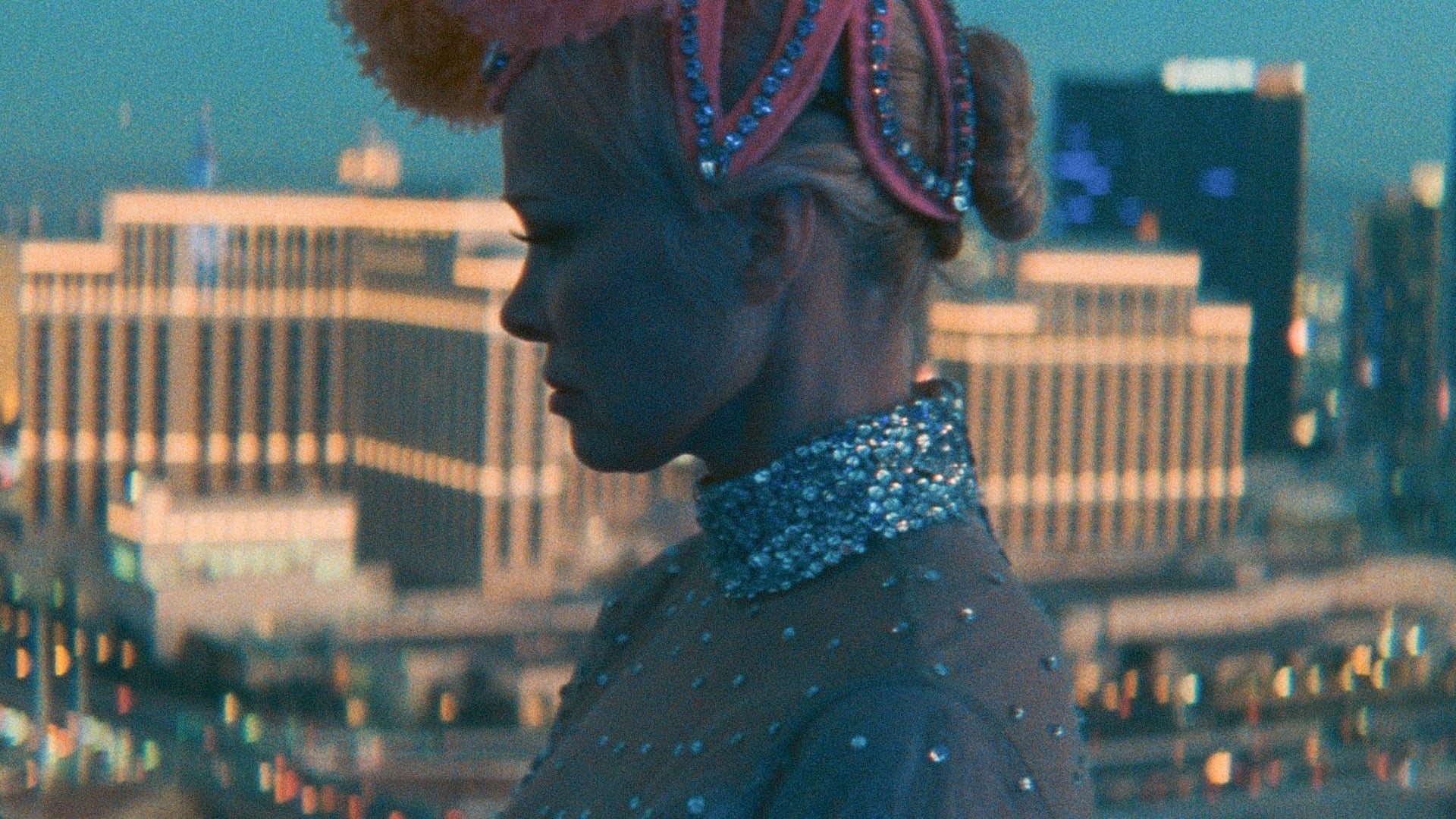
It’s called The Last Showgirl, and it (probably unintentionally) slots into thematic ground already tread beautifully this awards season by such films as Anora and The Brutalist, but that’s not so much a distraction as it is an intriguing parallel. Our world has changed more in the last century than ever before, and within that century was all kinds of systemic and societal change, on both a micro and macro level. The Last Showgirl turns the spotlight on the performers in a song-and-dance casino revue, The Razzle Dazzle, and how they react when the show is abruptly canceled, and the constant stability of their lives is irreparably disrupted.
It’s an interesting perspective, and one aimed at lifting the veil and humanizing the female performers and dancers who dedicated their lives (to varying degrees) to producing art that is evolving and changing faster than they can keep up with, as audience demand seems to change day by day. These characters are confronting the fear of irrelevance and in a perfect world, they would meet it with the perseverance and resilience that would make them the most easy-to-root-for characters in the world. But alas, they’re only human, and Coppola’s commitment to making these characters feel like real people goes a long way.

At the very center of the mess is Shelly (Pamela Anderson), who has starred in The Razzle Dazzle for three decades and finds herself hopeless and aimless after she learns of its demise. Anderson’s casting is one of the many “meta” endeavors the film makes, and putting her back in the limelight as a woman trying to make sense of her life after an unexpected tangle of events entirely out of her control causes her to recontextualize all of her experiences is certainly not an accident. And it pays off – Anderson was very recently nominated for a Golden Globe for this performance.
Joining Anderson are Jamie Lee Curtis (recently Oscar-winning for Everything Everywhere All At Once), Brenda Song (The Social Network), and Kiernan Shipka (The Chilling Adventures of Sabrina) as Shelly’s friends and co-workers. They’re all excellent, but I have to celebrate Song’s return to the big screen and Shipka’s increasing ambition in choosing challenging roles – for every Red One, there is a Longlegs. Dave Bautista, who has delivered on his intention to star in more dramatic and human roles after his larger-than-life turns in Guardians of the Galaxy and Dune, plays Eddie, the producer of The Razzle Dazzle and an uncertain figure in Shelly’s life. Everyone is brilliant here, but Anderson and Bautista are on another level entirely, and when they share scenes together, they build off of each other astonishingly. The Last Showgirl might be worth seeing just for them; as the nature of their relationship comes into focus, the film becomes more reliant on dramatic clichés, but their performances never falter or give way to the tropes the narrative around them is embracing. It’s tougher than it looks.
I enjoyed The Last Showgirl, but I wasn’t wowed by it – but the more I think about it, the more I wonder if that was the intended result. Shelly is so used to The Razzle Dazzle because she’s done it nearly every day for more than half her life, but she still loves performing in it. She lives for it. She’s become the show’s centerpiece, and through it, she’s found her community and her family (speaking of, Billie Lourd plays her daughter, which as a whole, I found to be some of the least effective character work in the entire film), but to an outsider, the show is stale and outdated. It’s antiquated. It’s not in style anymore. The most important part is how she feels about it, though – if Shelly loves performing just as much as she did when she started, why should it matter what anyone thinks? Why should it matter if I wasn’t blown away by the film if it has enough raw emotion and compassion for its subject to sustain it?

The title, for all intents and purposes, is both a description of its subject and its statement. Sure, it’s about the last of these shows closing its doors, thereby eliminating the titular last showgirl. It’s just not the type of person that exists anymore, and Gia Coppola’s film is asking why through a love letter to the big, Broadway-style musical performances that dominated casinos and gambling dens for decades. It’s sweet, in its own way – The Last Showgirl is attempting to preserve the art form by criticizing its lack of appeal in our modern world. It does so through the route of character study, albeit in an all-too-predictable dramatic styling we’ve become quite used to…and yet, when I listen to Miley Cyrus’ Golden Globe-nominated original song, “Beautiful That Way,” it makes me reconsider whether or not it matters that The Last Showgirl’s ending went exactly the route I expected. As Cyrus sings, she is beautiful that way, and so is the film’s intention. The final scene continues to stick in my mind’s eye, and I found myself won over by the time the credits rolled. Perhaps it’s Gia Coppola’s refreshing lack of cynicism, but I’m a sentimental soul. Give me an intimate portrait of the indomitable (but fallible) human spirit, and I’m all in.
The Last Showgirl opens in limited theaters on December 13, before expanding to a wide release on January 10.

Leave a Reply