

Welcome to class! My full-time job is working at a university, and I teach as well. One of my dreams has always been to teach a film class. Taking students through the world of cinema and helping them learn about the art form that I am so passionate about would be an amazing experience. But alas…I teach math. This series, “Lessons from the Wasteland,” is my opportunity to offer readers a curated watchlist to learn through doing (…watching movies). Each film on this list will highlight a filmmaker, sub-genre, filmmaking technique, or significant topic in order to broaden your cinematic horizons. For this month we have…
Non-Linear Storytelling
The Killing (1956)

Stanley Kubrick never did what was expected of him. With each of his projects, he defied expectations and produced films that would shock, surprise, and challenge his audience. That is no different for his early career heist/noir film, The Killing. The heist film formula is quite familiar today with the likes of Rick and Morty even taking it to task and lampooning it as the central gag of an episode. But there are a lot of ways to play around with the heist structure. You are not bound by a linear format, and even to that point, the film will probably work better if you avoid the constriction of the linear framing.
With a heist, you can tackle its storytelling in multiple ways. Kubrick decided to break it down through the members of the crew. The first half of the film navigates things in the way you would expect now (especially after seeing so many heist films). You have the “getting the team together” narrative beats. This is usually either fun or compelling, because you get to see each of the characters revealed and learn enough of them. But once the second half arrives, Kubrick shakes things up. Instead of playing out this tale in order, Kubrick decided to take each character and go from there. We begin with one of the characters, go through the whole heist, then the clock is turned back and the next character affords a whole new perspective. This approach allows layers to be pulled back on the heist, and builds suspense as we wait to see if things work out properly.
Because of this, each character gets the opportunity to shine, with Sterling Hayden’s Johnny standing out with his iconic mask and gun as he commits the “stick up.” Each beat in the story allows us to highlight how the mission needs everyone to pull their weight and knock down the series of dominos. There have been plenty of heist films after The Killing that have played around with mystery during the proceedings, then taking a step back to reveal how it all really played out. Without a film like The Killing (which dabbles in the crime/thriller, noir, and heist genres), you would not see other heist films taking risks and playing around with the inherent mystery that builds as a mission like this is attempted.
Kubrick was a genius for all that he did behind the camera and the ways he pushed cinema into the future. The Killing is a much smaller and lesser known film of his, but it still captures the dynamic filmmaking that he had all along.
Harakiri (1962)

How much steam can you get out of a story about a man showing up to die by suicide in front of a feudal lord? Harakiri seems like it will be an isolated and tight samurai film, but it soon peels back a multitude of extra layers. Director Masaki Kobayashi is a legendary artist in the realm of Japanese cinema, with his work including The Human Condition series. But it is Harakiri that has become his magnum opus. This is the tale of a ronin who shows up at a feudal lord’s palace to commit seppuku, though things become more complicated and compelling as the layers are revealed when it comes to the motivations of this ronin. This is not a simple tale of this man showing up at a convenient place and just needing the official experience of ritual suicide to meet his goals. Death was not meant to be in the cards. Kobayashi’s story plays around with so much, making it a complex film that never feels like it was meant to be played so simply. There is a purpose for this ronin’s visit, and why it must be this palace and this lord to witness his self-inflicted demise.
Instead of this being a simple slow burn, with tense banter back and forth, the film takes the audience into the past on multiple occasions to reveal the tension that is really bubbling underneath. Why does this storytelling mechanism work so well in this context? Mystery. So many questions begin to mount when this man shows up on the palace doorstep. He continues to draw out the ceremony. There seems to be more going on than we initially thought. We’re hooked and invested in finding out what is really going on. That is the magic that Kobayashi is able to pull off. Then we see the truth. We see the trauma that exists in the background of this man as his true motivations are revealed. There is plenty of suspense and tension building in the present time frame, but it is the weight of the loss and tragedy in the past that gives this film its impact. Outside of the wild climax of the film, we are treated to one of the most impressively shot samurai battles ever put to film…but Kobayashi doesn’t just leave it there. How much of these previous events are even true? His mastery of this unique format is further proof that Kobayashi was a master storyteller, and Harakiri is his masterpiece.
Annie Hall

What makes Annie Hall such a unique romantic comedy is that we do not visualize a relationship from start to finish. We see a relationship through time, and at different stages. This was a bold and fresh take from Woody Allen which would be replicated by other filmmakers in the years to come (looking at you, 500 Days of Summer). We are dropped into a relationship that has already been going. We are not blinded by the honeymoon glee of the start or the darkness projected out of jaded perspectives. We see Alvy (Woody Allen) and Annie (Diane Keaton) on a date that provides context to their dynamic, including what works and doesn’t work. But over the course of this lean, 90-minute film, we get to see all the elements of this human connection. After the initial meeting (with its spark and wide-eyed optimism), we see the aftermath with measures of conflict and resentment sitting in, and Alvy trying to recapture and reimagine his connection with Annie in a new relationship.
Romantic comedy is such a formulaic and, honestly, boring genre at this point in cinematic history because few filmmakers are bold and ambitious enough to try something new and different. The rom-com has become the chicken noodle soup of film…familiar, comforting, but generally bland and dull. But seeing a film that is almost 50 years old trying something unique and compelling is quite shocking. Why then and not now? Allen was a filmmaker who had enough ideas to make this romance stick out in a post-screwball comedy era of filmmaking. The screwball comedy took hold of romance on screen for decades, and in the ’70s, audiences were ready for something different and more challenging.
Annie Hall is a complex and layered romance. The story structure levees some complexities, because it forces the audience to reconceptualize the known process of a relationship. The characters are fascinating, and Alvy is not likable in the way that many romantic leads are expected to be. Neurotic and frustrating, Alvy fits into the context of this twisted romance in such a compelling and engrossing way. We do not need to see things played out in such a simplistic way. The layers are all eventually peeled back, and Alvy and Annie’s relationship finally comes into full view. The journey is messy and keeps you on your toes, which works perfectly for a story centered around such a strong yet flawed connection.
Pulp Fiction
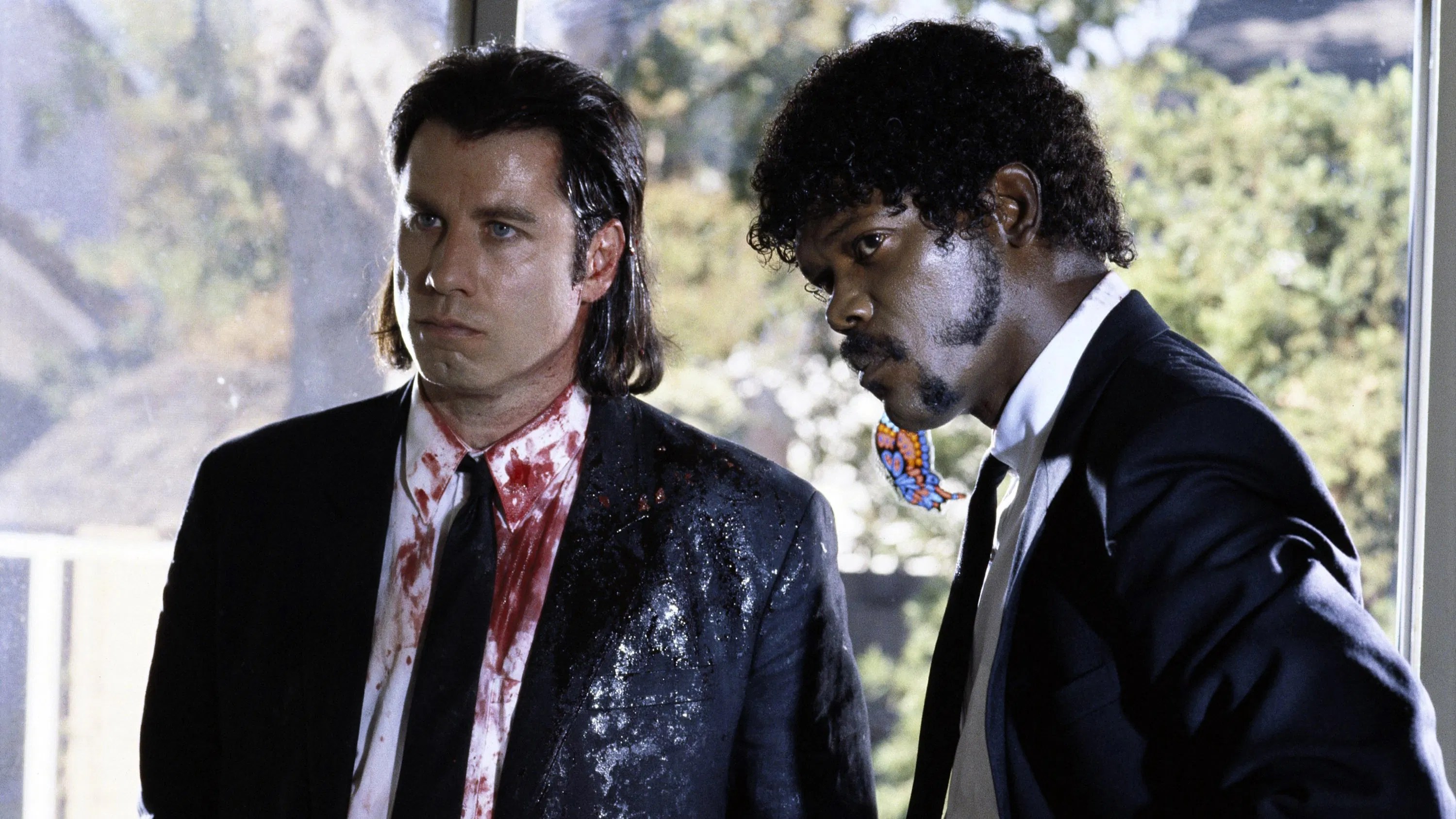
Tarantino is perhaps the director most known for his non-linar stories. Reservoir Dogs put him on the map with such a reputation, but it was Pulp Fiction that really solidified this approach as a device that Tarantino continued to play around with.
Pulp Fiction has such an interesting and dynamic structure of storytelling that maintains plenty of mystery and intrigue. What seems like a random opening sequence between a young couple in a diner is revealed later to be the catalyst for one of the film’s most important and interesting character shifts. There are three main storylines that are told in their own way, as they each take up about a third of the space. We have characters who are the leads in some and take a backseat to others. We even witness the death that makes seeing those characters again later even more interesting. John Travolta’s Vincent Vega is the lead in the first third, a character whose fate is shocking in the next, and basically a co-lead or top-tier supporting character in the final stretch. Travolta gives one of his best performances (period) in Pulp Fiction, and he gets to navigate this overall narrative in such a strange yet effective way. Samuel L. Jackson’s Jules leaves an impact in the first third, but disappears after making a life-changing decision. How does he come to this? See: the last third, where Jules is front and center and comes face-to-face with our violent couple from the opening prologue. We have a fleeting glimpse of Bruce Willis’ Butch in the first part of the film, and find out how significant he will be to Vincent’s story later on.
The collection of pulpy crime stories is a violent, cool, and entertaining experience that feels like a strange love letter to L.A. But it is the layers of stories and characters that makes this film stand out in such an impactful way. Tarantino packed his film full of needle drops, unique characters, and familiar faces you have seen in the movies for decades. Tarantino is a “student of the game,” leveraging his wide cinematic palette to transform his films from what could have been a standard affair into something special that channels so many things that he loves about film. Pulp Fiction could have been told in linear fashion, but it is the web of narrative beats that makes it feel so engaging.
Memento

How does a director get away with telling their film’s story in two separate pieces that are being told in opposite directions and somehow collide in the center? Well…Christopher Nolan makes it look easy, and no less impressive. His Hollywood debut, Memento IS an impressive cinematic achievement that should be studied and explored for years to come. Nolan is iconic in the world of film, and his reputation has been built on the ideas of “puzzle box cinema.” Each film is filled with mystery and intrigue. You might not always be 100% on board with the heady and intellectual personality that Nolan brings to so many of his films, but part of the fun is peeling back the layers on the stories Nolan has put together. This approach, and the iconic cinematic trait, all began with Memento. Usually, you only see pieces of what is to come, but Nolan delivers one of his most complex narratives right out of the gate with this one.
Memento is told in two pieces. The first is initially told linearly, and is shot in black-and-white. From the opening moments until the climactic and shocking middle sequence, Guy Pearce takes the audience on this mysterious ride as he speaks on the phone about his life, memory condition, and mission all through the phone (which is against his own rules). This piece of the film slowly elaborates on the mysterious character that is Leonard. The other half (shot in color) is presented in the opposite direction. The end of the actual narrative is just the beginning of the film as a whole. The fact that the climax of the story is really the middle bump in the center is quite the surprise. The middle events recontextualize the whole film and our protagonist, which explains why it needs to be presented as the final moments of the film.
What we see first is the demise of a significant character in the film. But we do not know why this death is significant. That is what is revealed throughout the film as layers continue to be pulled back. We begin to see the darker edge to each and every character, because the lack of new memories (that Leonard struggles with) is the perfect masking agent for some dark and twisted people.
Challenging as it is satisfying, watching Memento for the first time must be a truly unique experience. All of Nolan’s “puzzle boxes” and shuffled narratives have been unpacked again and again over the last few years, but when you take a step back and see what is truly significant, it all begins to crystallize. There are plenty of twists and turns along the way, but nearly 25 years later, we have come to appreciate this film for what it really did. It put Nolan on the map, and we have been treated to plenty more non-linear stories from him since.
Also see: Citizen Kane, Rashomon, Mulholland Drive, The Prestige

 Knock on Wood
Leave a comment