

Luca Guadagnino is an interesting case. He first gained recognition in his native country of Italy for his odd, cerebral, character- and dialogue-focused dramas, but since his international breakout with Call Me By Your Name, most of his films have been bigger, stranger, and weirder. Suspiria did the impossible and successfully remade an Argento classic, Bones and All gave its audience the gory love story they didn’t even know they wanted, and Challengers was…well, a small phenomenon.
Guadagnino’s latest, After the Hunt, has the spirit of his older work – it’s not as bombastic, frantic, or high-concept as much of his Hollywood-sponsored output – but it maintains the star power that he has come to be associated with. After the Hunt follows in the cultural wake of the MeToo movement, decidedly contextualizing itself as a film that could not have been made anytime before the domination of our modern social values.
Julia Roberts stars as Alma Imhoff, an acerbic college professor with self-destructive tendencies, alongside Andrew Garfield as her colleague and close friend Hank Gibson, and Ayo Edebiri as her protégée Maggie Resnick. One fateful day, Maggie approaches Alma with a disturbing accusation – that Hank sexually assaulted her. An ominous ticking clock continues to guide Alma through her life, as she is left reckoning with both her own role in the situation and a nasty secret from her past.
It’s an interesting point of view – the story is told from the perspective of the person caught in the middle of the event, with a very important relationship with both parties. It might have been more successful if any of these characters were even remotely likable – as it stands, every one of them is fairly insufferable, which I fear may be part of the intention. It’s harder (or perhaps easier) to point fingers when there’s no good solution and nobody looks good on top of it all. Unfortunately, it also doesn’t make it easier to find someone to root for, and that’s a tough obstacle to pass.

The film (very intelligently) interrogates how privilege has changed over the years, and what it means to the current generation of young people. Do they feel entitled to certain things? How does that affect those around them? Does the movie even have an answer to all of these questions, and is it interested in answering them in the first place?
As is always the case, Luca Guadagnino’s camera has an extraordinary life of its own, and that’s where After the Hunt finds its greatest strength. Sure, the performances are solid and the dialogue is good (Michael Stuhlbarg, who plays Alma’s irreverent husband Frederik, is especially effective with everything he both is and isn’t given), but I’m far more interested in the film’s self-critical stance, nakedly showcasing its own ideas to be judged outside of itself, as if reminding us that we are watching a movie. It’s bold, and as someone who has worked on several stage productions where that kind of audience awareness is exactly the intention, I found it fascinating, if a little perplexing.
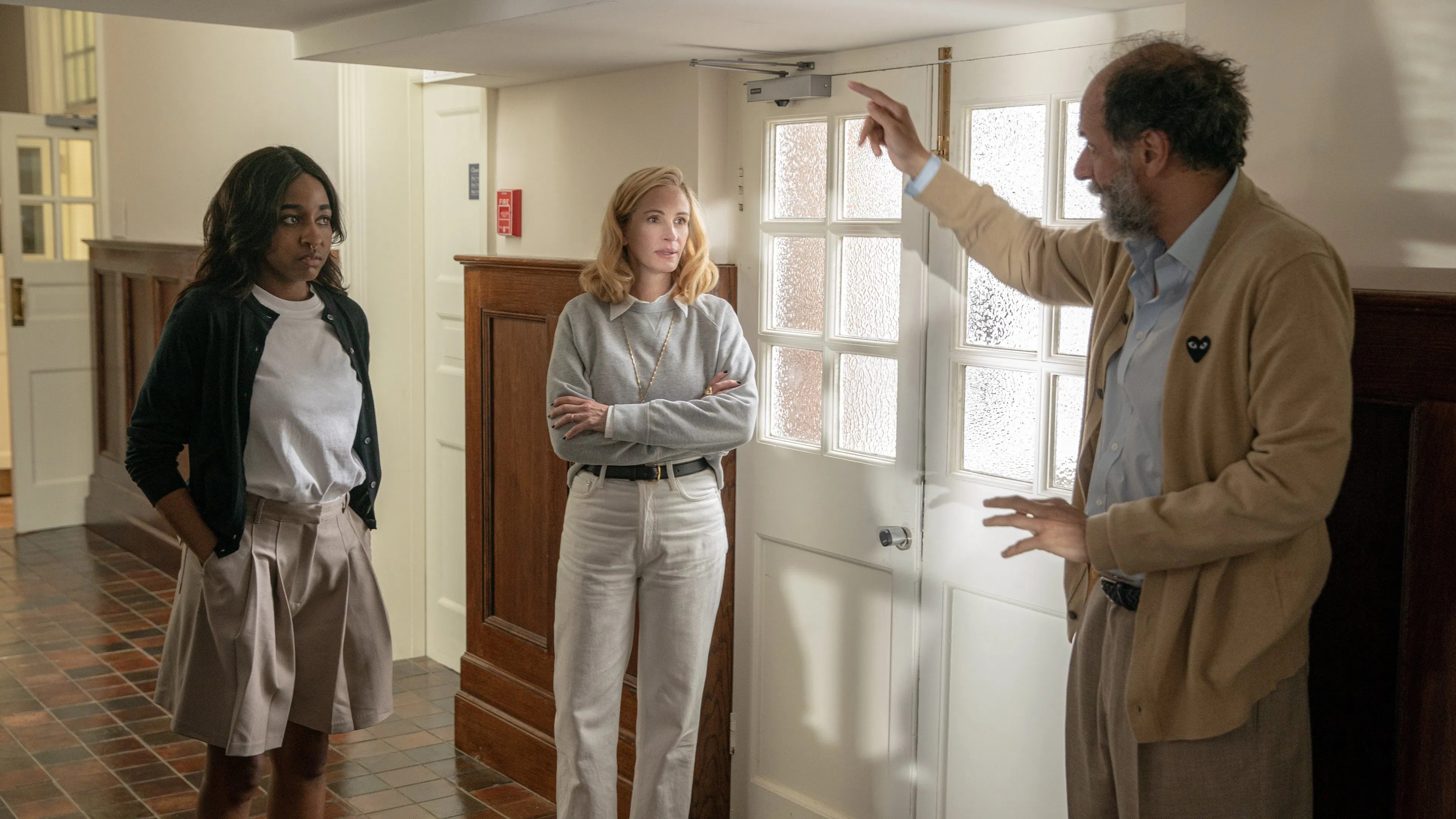
I’ll be entirely honest and admit that Luca’s films have historically been hit-or-miss for me. I wasn’t at all a fan of Bones and All, but I loved Challengers. I wasn’t in the bag for Queer, but I adore Call Me by Your Name. He’s a filmmaker of many flavors, who obsesses over a number of central concepts in nearly every one of his works – chiefly, desire and passion, including their effects and consequences. After the Hunt is no different.
After the Hunt opens in limited theaters this Friday and nationwide on October 17.

 Knock on Wood
Leave a comment