
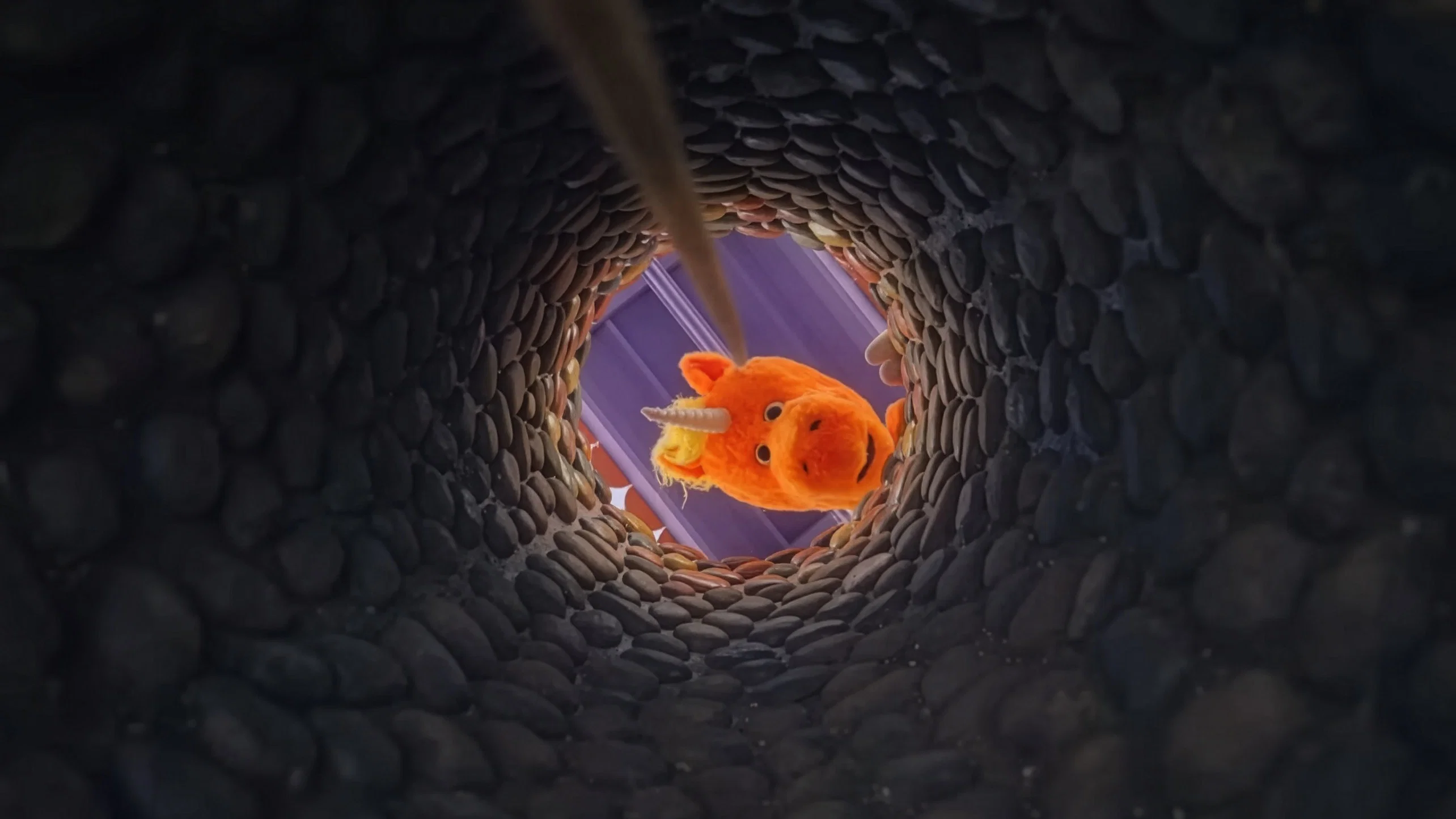
We all remember Buddy, right? The friendly, magical orange unicorn that dominated our television screens in the 1990s, singing about sharing and bravery and hosting dance parties in his picturesque cartoon park. We love him, and you better believe the children and puppets who live in the park love him too.
Do we remember those times when he wasn’t so friendly?
Those times when things just felt a little…off? It didn’t happen often, I know, but you always had a feeling. You might not have been able to verbalize it, and you might not have even realized it was there, but it was. Trust me.
But we ignored it because the show made us happy. It allowed us an escape into a fantasy world where none of our pain, trauma, or emotional distress could follow. For thirty minutes every weekday, we had a place to go, and we went there together.

Such is the experience of watching a very particular era of children’s television. When we were kids, we wanted for nothing while it was on. It was an escape, but it was also educational. You come away from each episode with a new, positive idea to incorporate into your daily life. Even if it was unconscious, it was there, and that was valuable. It made these shows worth watching.
But you can’t deny that something was lurking beneath the surface. You might not have realized it at the time, but as you came away from each episode feeling enriched, a part of you was…disturbed. This was another one of those feelings you couldn’t quite put into words at this age, but it was there. You didn’t know how to bring it up to the adults in your life, but it stuck with you for years after you stopped watching the show. Now, when you revisit it, it doesn’t quite feel right. You can try to convince yourself that it’s just as good as it always was, but that nag won’t go away. There will forever be something beneath the surface that, under any circumstances, you cannot be rid of.
Now imagine that each episode of that show you’re picturing is actually a hellish loop in which a psychopathic monster literally holds the entire cast hostage under the guise of perfect televisual bliss. Congratulations, you’re well on your way to envisioning Casper Kelly’s Buddy!

This disturbing puppetry-reliant thriller feels like a natural evolution for Kelly, who is best known for surreal Adult Swim programming like Too Many Cooks and the Yule Log duology. Much of his work concerns the subversion of conventions that simultaneously play on nostalgia – Too Many Cooks, for example, is a horror-themed lampoon of sitcom opening title sequences. Buddy ratchets it up a notch (to be honest, it’s more like several notches) for a drug trip of a feature film that skirts the edges between traditional film structure and hazy, half-remembered dreams.
There’s a human cast, and they’re fantastic, but they’re best kept a surprise. The real star here is Buddy, with all his unpredictable orange fire. He’s no different from the controlling personality behind the scenes of nearly every single one of these shows Buddy uses as inspiration – men who believe they can do what they want whenever they want to whomever they want. They want things to go a certain way, and if they don’t, those people get angry. They never allowed the public to see it, because they knew it would be the end of them and the end of their show. In that way, they made the audience complicit in their bad behavior – if they could hide it well enough, it wouldn’t be felt on the show…right? As long as people watch, nobody will notice, and everything will be okay. Best if we don’t talk about it.

Buddy is a “blind movie.” We don’t get them too often in the age of viral internet marketing, but this is a movie that has managed to escape the reach of widespread knowability before its release. It’s a real credit to the strength of its premise, and a trust that the right people will show up. It’s not just a nuanced allegory for the aforementioned abuse on the children’s television series of the late 20th century – it’s also a thrillingly strange horror picture, albeit one that circumvents nearly every tool deployed in modern genre cinema. It’s singular and exciting and hilariously dark, chiefly because it’s not afraid to confront its audience with unabashed truths, some of which we would rather ignore. We accept them here because it’s a movie. We know it’s fictional, and thus, it’s incredibly easy to compartmentalize.
But it still works. It still worms its way into your head and stays there, festering while you are distracted by the dopamine and satisfying memories it leaves you with. Buddy is a wonderful film – in a year full of great horror, it stands out amongst other wholly original offerings like Obsession and Hokum – but it leaves you with a similar acidic feeling to a revisit of your favorite classic children’s TV series, an aftertaste tinged with salt. It’s not wholly unpleasant, but it is unmistakable.
Welcome to the world, kid. Just do what they tell you to do and say what they tell you to say, and you’ll be fine. Trust us. It’s better this way.

Leave a Reply