

Welcome to class! My full-time job is working at a university, and I teach as well. One of my dreams has always been to teach a film class. Taking students through the world of cinema and helping them learn about the art form that I am so passionate about would be an amazing experience. But alas…I teach math. This series, “Lessons from the Wasteland,” is my opportunity to offer readers a curated watchlist to learn through doing (…watching movies). Each film on this list will highlight a filmmaker, sub-genre, filmmaking technique, or significant topic in order to broaden your cinematic horizons. For this month we have…
Weird Westerns
El Topo

“Weird” is a great word to describe Alejandro Jodorowsky, but his film El Topo is not exactly what you would generally expect from the “Weird Western” subgenre. Most Weird Westerns possess all the basics of the broader genre, but inject different types of genres to craft something stranger and more unique. That is not El Topo. This is a full-blown avant-garde experiment that leans heavily into the surrealist trappings of Jodorowsky’s works and perspective. Don’t go in expecting clear and easily processed narrative elements. You will instead be treated to an enigmatic experience that could only be brought to life with such confidence and ambition.
The actual story of El Topo follows a mysterious black-clad gunfighter and his son who wander a mystical Western landscape, encountering bizarre characters along the way. Fantastical and adventurous, El Topo delivers a wild experience that recontextualizes the genre that it is a part of. Jodorowsky himself portrays this enigmatic drifter (and his real-life son plays his character’s little boy), which gives the film those classic western loner/drifter vibes. What makes it so impactful is the strange world and visuals that Jodorowsky crafts for this alluring western. Westerns tend to be a more grounded and “salt of the Earth,” but Jodorowsky brings his avant-garde penchant for subversion to the genre. The stark visuals (such as the man in black standing with his naked child) stand out compared to more classic and traditional Westerns from Ford and Hawks. The atmosphere is ethereal and strange, with each frame of the film offering up something intriguing and engaging.
The pace is not one for thrills or entertainment. This is a reflective and contemplative exploration of the world and the people that populate Jodorowsky’s strange universe, who make this such a unique and offbeat experience. Jodorowsky also explores occult imagery and Judeo-Christian and Eastern visuals. This is not an easy film, or, more importantly, it’s not a simple film. El Topo is there to challenge you and make you process the unexpected. Few filmmakers mix such conflicting and different perspectives, but Jodorowsky wants this classic genre to be put in an unexpected place that subverts the expectations of the audience.
Westworld (1973)

Were you on the Westworld train thanks to the HBO series that confused audiences for years? The series launched a major television moment, with the first season capturing the imagination of viewers. But there is a very different original Westworld, which this show stemmed from in the first place. Legendary Michael Crichton (the creator of Jurassic Park) took his pen to the screenplay and got behind the camera as well for a film is much more of a basic and lean kind of thriller.
We do get to see rich folks living their vacations in a variety of settings, from a samurai world to medieval times to…you guessed it, a western town! This genre-bending film is exactly what you would expect a weird Western to be. There are heavy science fiction elements, with whole worlds filled with fully functioning artificial intelligence in the form of robotic beings. The classic tale of when the machines can no longer be controlled and threaten humanity has been done so many times, but this is a fresh new take on that trope.
There are plenty of horror/thriller elements, as Westworld is not unlike a slasher flick (or quite close to the original Terminator model of unrelenting antagonists who will stop at nothing to kill their targets). Yul Brenner plays an unblinking, unrelenting force that hunts our two protagonists (including James Brolin). You generally don’t get a lot of horror elements in Westerns, and that makes them stand out here. The “Man in Black” robot that Brenner portrays has become so iconic (with him pulling from figures like Jack Palance in Shane). The script is lean and effective, showcasing a variety of people getting stalked by samurai, knights, and, of course, cowboys. Even though it is not the whole film, the western aspect of Westworld is the key fixture. There would be no Terminator without the work of Crichton, and that is the type of impact this B-genre flick has had on cinema.
Cannibal! The Musical
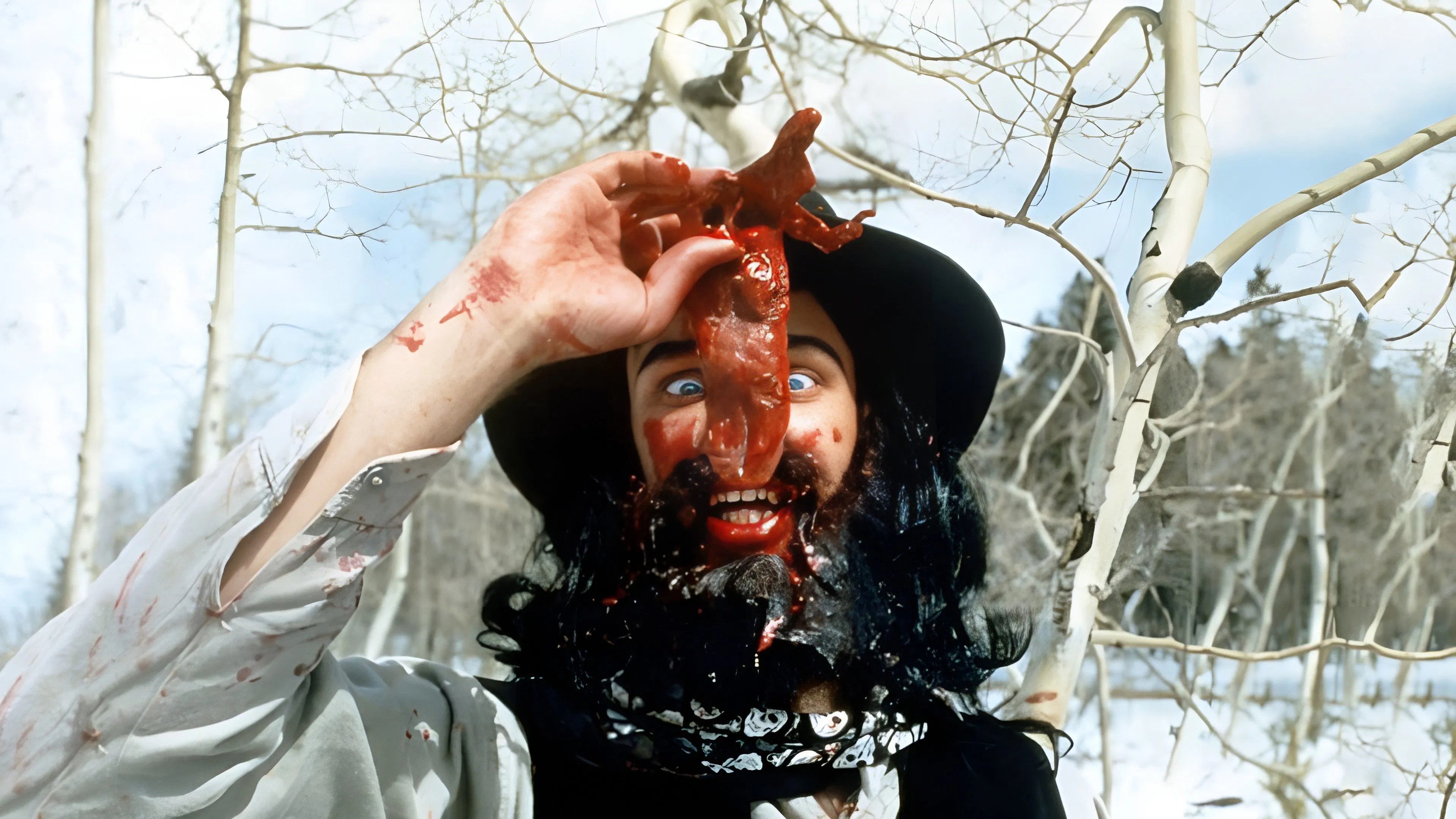
How many musical westerns have you seen? There are some classics, like Paint My Wagon (yes…Clint Eastwood starred in a musical) and Oklahoma. There are fun animated films like An American Tail: Fievel Goes West and Home on the Range. But the most unique of them all comes from an unlikely place. Cannibal! The Musical made its start at the University of Colorado Boulder when two young men decided to make a film together. Trey Parker and Matt Stone. Yes…the South Park guys made a college film about cannibals in the form of a musical. The tale of Alfred Packer, a man who had to turn to cannibalism in the wilderness certainly does not scream “This needs to be a musical!” It’s a local tale – Parker and Stone are Colorado natives who grew up with a legend like this. Cannibal! The Musical certainly feels like a student film with its low budget and amateur actors (including both Parker and Stone), but there is a charm to that kind of film.
This campy and silly musical with such dark subject matter makes for such a unique experience. The frontier and mountainous setting certainly channels the Western vibes with a pioneer feel. It’s a survival film as well as a Western (and comedy…and musical…and kind of horror) with the struggle for Packer attempting to survive this rough journey from Utah to Colorado while the rest of his team died…and were partially eaten. Packer is not the most serious or brightest man, but he must find his bearings as he loses his way trying to find his missing horse in the mountainous wilderness of his trek.
There are a few elements of this film that shake up the Western formula. The humor is silly and campy, and shows the wild sense of humor that Parker and Stone would get rich off of thanks to South Park. The horror elements are bloody and suggestive, as the film questions whether or not Packer actually committed the acts we see play out on-screen. But the musical elements are certainly the most fun aspect, and some of the most unexpected parts of a Western. “Shpadoinkle,” “Trapper Song,” “Let’s Build a Snowman,” and “Hang the Bastard” are just a few of the fun and catchy musical numbers that Parker composed as he lampooned such classic musicals as Oklahoma.
The Good, the Bad, the Weird

“Weird” is in the name, isn’t it? This South Korean western comes from a cinematic landscape that you would least expect to find a Western. Korea doesn’t scream “Westerns really speak to us.” The international flair of Westerns has expanded to other North American countries like Canada and Mexico, while also spreading across the world with Italy and Australia each branding their own Westerns (“spaghetti” and “meat pie” respectively). But Asian cinema is not necessarily a place you would expect to see many films that capture the Western vibes. That did not stop Kim Jee-woon from channeling some admiration for spaghetti westerns like The Good, the Bad, and the Ugly to craft this wild and fun Western.
This film takes place in Manchuria during the 1940s, a setting that fits better with the atmosphere and motifs of the Western. The film finds two outlaws and a bounty hunter who are stuck between the Japanese army as well as Chinese bandits. Channeling the war backdrop of The Good, the Bad, and the Ugly, this Korean western explores a significant period in Chinese history during WWII when the Japanese were occupying sections of China. This makes for a dangerous and tumultuous environment for the film’s narrative (and characters) to play around in. What makes this Western so unique is the Korean cinematic style and voice that is injected into the film. There are plenty of expected Western elements that are present here, from desert settings, horse stunts, shootouts, and more. The crisp filmmaking, gorgeous cinematography, and aggressive symmetry in many shots also stands out and reinforces the works of directors like Sergio Leone (an obvious influence on this film).
The way the violence is presented feels more Eastern cinema than Western cinema. There is a great injection of humor and absurdity that makes the film feel so fresh and engaging. The stunt work is campy and over-the-top in the way we expect it in many martial arts films. Having that vibe and voice injected into a western makes The Good, the Bad, and the Weird feel so unique in the realm of Westerns.
Moral ambiguity is not unique in Westerns (especially spaghetti Westerns), but this film does lean even harder into the strange and fun characters that bring a lot more humor to the proceedings. The martial arts influences and more campy elements make this feel entirely unique. There is consistent humor and absurdity on display, and that makes for a fully engrossing and fresh take on this 100+ year old genre.
Bone Tomahawk

Are you ready for some truly horrific elements in a twisted and brutal Western? Many classic Westerns have a feeling that you are watching a movie, with the studio backlot settings that feel a bit too polished for a period that is so gritty and dirty. Bright and gorgeous, many classic Westerns deliver engaging visual experiences with bold colors and dynamic camera work. But the West was not those things. Nature is certainly beautiful, but life back then was dusty, dirty, and coarse. Filmmaker S. Craig Zahler went out to make the dirtiest, grimiest, and most brutal Western in the history of cinema…and he just might have succeeded with Bone Tomahawk. This film does not have a large budget (and it shows), but Zahler leverages this feeling by crafting a simple yet effective Western landscape.
The grittier look might come from this being an indie project, but this grit works well for crafting the atmosphere. This is not a hopeful film, nor is it a bright and electric film. It’s grim. Brutal. Stark. The four men who go on a rescue mission to save a few townsfolk (including the wife of one of the men) are riding into Hell…and Zahler makes sure we feel that. This looks like a desolate wasteland, with no green, just the stark desert ahead. The climactic sequences of this film take place in a dark and grim cave that has minimal lighting from the firelight. It really sets the mood for the horrific things you will see in this place.
There are a few elements of the film that Zahler leverages to create terror. The idea of a cannibalistic tribe of Native Americans is in itself a concept ripe for horror. Casting large and burly men to portray these warriors gives them added presence. The hair and make-up that is used is eerie and unnerving. But it is the apparatus that they have in their throats that allows them to shriek that is downright terrifying. The sound design is horrifying. Eerie and aetherial, these noises really set the tone. But the actions of these men are what really make this film so frightening.
Bone Tomahawk is not for the faint of heart. This is a brutal, gritty, and horrifying cinematic experience. Zahler is able to balance that with rich character work and memorable performances. Kurt Russell and Richard Jenkins bring their veteran talents to this story, while Patrick Wilson bravely displays great determination and Matthew Fox is a swaggering gunslinger (at least, he claims to be). This might be too much for some, but this is a Western that transforms the genre while still honors its legacy.
Also see: The Quick and the Dead, Ravenous, Billy the Kid Versus Dracula

 Knock on Wood
Leave a comment